

Meet Daily Point of Light Award honoree Emilio Saenz. Read his story, and nominate an outstanding volunteer or family as a Daily Point of Light.
When Emilio Saenz’s friend Andrea moved from Mexico to Arizona about two years ago, she was placed in an English-only program where she couldn’t understand her teachers, and she eventually started to fail her classes. Emilio, who grew up as an English learner himself and whose parents are both immigrants from Mexico, went looking for bilingual programs that could help students like her. He found there was no public directory to turn to.
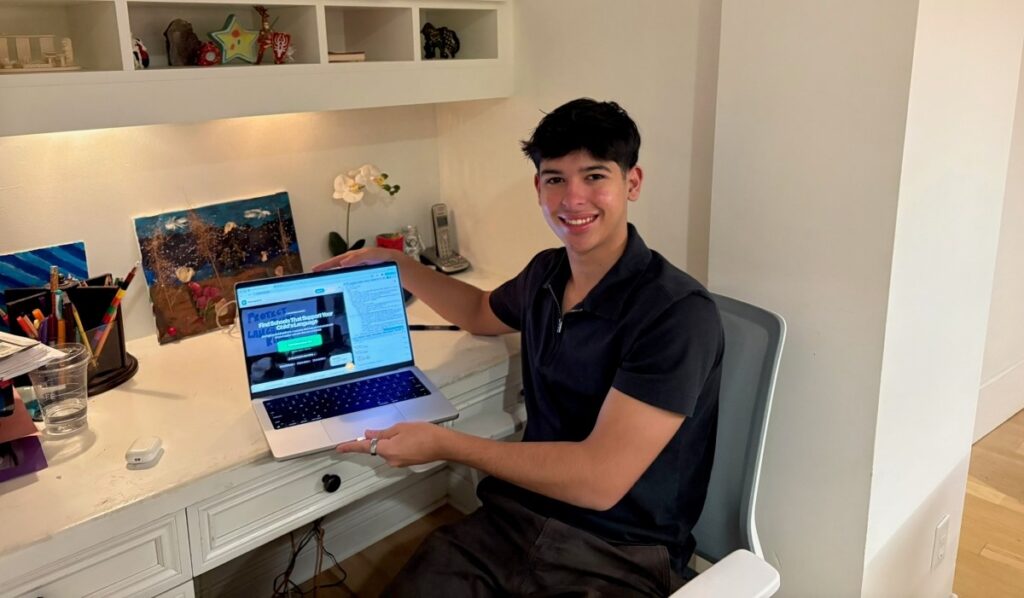
So Emilio, now a 16-year-old high school junior in Phoenix, began building NaveganteAZ in December 2025. Using an AI-web scraping tool to search school district websites and public records, he built a free website that helps families find bilingual and dual language programs across Arizona. Today, Emilio leads a team of 15 student volunteers and more than 2,000 people have used his site. He also chairs the Arizona State Board of Education Student Advisory Panel and mentors other students through Impactfully, a company he founded to help teens launch community projects.
What inspired you to start Navegante?
Navegante is the only existing directory of bilingual programs in the state. It was inspired because I grew up as an English learner. I didn’t speak English and had to learn it in school because my parents are both immigrants from Mexico, so I’ve always had empathy for English learners. But my focus on bilingual education was motivated by my friend Andrea, who moved from Mexico to Arizona about two years ago. She didn’t speak any English, but she was placed in an English-only program where, as you can imagine, she was failing her classes because she couldn’t understand the words her teachers were saying. That’s when I realized how hard that situation can be. How do we expect kids like Andrea to graduate and go to college when they can’t even understand what their teachers are saying? I learned that English learner graduation rates in Arizona hover around 50%, which is super alarming.
I did some research and found out about bilingual education programs. I also serve as chair of the State Board of Education Student Advisory Panel, so I talked to some people on the board about it. I learned that the scientific consensus is that these programs are optimal for English learners because they learn half the day in Spanish and half the day in English. They get their core subjects, like math and science, in Spanish while still learning English, and it’s proven to be better for their confidence, their academic progression and even their language acquisition.
But there was very limited infrastructure for bilingual programs, and the Department of Education no longer had a public directory of them. So I decided to piece the data together myself. I developed an AI web-scraping model that uses a Python library called Beautiful Soup to scan school district websites and public records, like school board meetings, for any mention of bilingual programs. I verify them and add them to the directory. That’s how Navegante was born. I also crowdsourced it, so now I get emails from teachers and principals saying, “Hey, add this bilingual program.”
How do families find Navegante, and what impact has it had?
It’s tricky to measure how many families end up going to these schools. Since we started, well over 2,000 people have used the website, and I’ve received well over 50 emails from parents and teachers. Sometimes parents reach out directly, like one in Pima County, a more rural part of Arizona. Someone on our team will research, call experts and recommend dual language schools in the area, so we do some custom help.
The most exciting email I ever got was the very first one, from a dad in Gilbert who said there were no dual language programs listed near him and asked if I could help. I was in my kitchen when I saw it, and it was insane to realize that a website I made in my bedroom had actually reached someone. I was going to help this dad potentially make an educational decision that could change his kid’s trajectory, his family’s trajectory, for years. The school you go to can matter so much, especially in Arizona, where school choice means you can attend any school, even outside your home district.
What has been the most rewarding part of your work?
Mentoring other students. After making Navegante, I realized there was a workflow I took to build it: spotting a problem, thinking about a solution, validating it, building it, iterating, and then launching. I learned a lot about pitching to media, launching programs and finding a problem that’s feasible to solve. So, I started a business called Impactfully, where I mentor other students to start the same kinds of passion projects that can do good for the community while also helping them build confidence and strengthen their college applications.
One of my students started out so shy and never imagined he could build a project that could help people, especially so young. He hasn’t launched yet, but he’s working on a website to help teachers better understand their students.
With the students at a Title I middle school called Pueblo del Sol, I’ve taken on a mentorship role. They’ll text me questions about high school applications and general life advice. A lot of them come from harder backgrounds and grow up with fewer resources, without the expensive college counselors some kids have, but they’ re so passionate that they’re going to get there anyway. Being able to mentor them is very fulfilling.
Why does equal access to education matter to you?
I believe every kid deserves an equal shot at chasing their dreams. My parents are both immigrants from Mexico, so I’ve seen firsthand that immigrants are some of the most hardworking people out there, and they’re often misportrayed in media and politics. My mentor always says, “Take care of your mind, and your mind will take care of you.” Education is how these kids, and how I can get where we want to go and have better opportunities than maybe my parents did. The students at Pueblo are hardworking, smart kids who sometimes don’t have the guidance or the resources, but when you put the opportunity in front of them, they take it so quickly and they’re so grateful for it.
Do you want to make a difference in your community like Emilio? Find local volunteer opportunities.