3 Ways People of All Ages Can Make the Most of International Youth Day
August 12 is International Youth Day, a United Nations effort to celebrate youth activists, combat ageism and help bridge gaps between generations working toward the same change.
No matter your age, it’s likely you’ve questioned your ability to make a difference. Our research shows that 73% of people believe that volunteering is more important than ever, yet 66% think they can’t make a big impact in their communities. Activists on the ground prove otherwise. That’s why we recognize thousands of volunteers for their contributions to their communities through t
“Points of Light’s research found that Gen Z is the most civically engaged generation to date. Our youth honorees demonstrate that people of all ages can strengthen communities and solve persistent problems,” says Diane Quest, interim CEO, Points of Light.
To inspire you to action this
International Youth Day
, we are sharing stories of youth honorees, along with three elements from the Points of Light Civic Circle®, a framework for helping people to become more civically engaged.
Volunteer
Nonprofit organizations and NGOs need volunteer power to deliver support to the communities they collaborate with. If you’re an adult wanting to facilitate youth volunteerism, consider organizing a youth-specific event or helping transport the young people in your life to an event. To find a volunteer opportunity that aligns with your interests and availability, check out
, a database with hundreds of thousands of in-person and virtual volunteer opportunities.
The power of volunteering shines when considering Daily Point of Light Award honoree Nate Buescher, a high schooler who prepares food for a local food pantry and distributes home-cooked meals to tent cities around Chicago. Buescher began fighting food insecurity at age 7 with the Honeycomb Project. Today, he mentors younger volunteers while maintaining his own service projects.
Voice
The youth voice is vital, pointing us to which concerns are most important to future world leaders and helping broaden perspectives. Use your voice to advocate for causes you care about by posting on social media, attending a rally or contacting a government leader. Adults can amplify youth voices by sharing with their networks, or organizing forums for youth to be seen and heard.
Seventeen-year-old Daily Point of Light Award honoree
used his voice when organizing a rally of fellow activists on the Washington State Capitol steps to support legislation protecting the Chinook salmon and orca populations. He also regularly addresses state legislators and travels statewide to speak to K-12 students about environmental issues.
Listen and Learn
Social justice and environmental issues are nuanced, involving many people with different perspectives shaped by their own experiences. Listening and learning is one way to honor others’ lived experiences and get a fuller scope of an issue.
Young people can commit to thoroughly researching causes they care about, talking to those working toward solutions and holding space for those impacted. Adults can connect with the young people in their lives, inviting dialogue that allows for sharing different perspectives and finding common ground.
These are the driving ideas behind the work of high schooler Kristie To, who became a leading force in Asian American racial justice when she founded
. Among the initiatives of her nonprofit is distributing Asian history and Asian American Pacific Islander civil rights curriculum to children.
“Cultural sensitivity starts with exposure, and that’s what we’re trying to do with these elementary schoolers,” says To.
To learn about other avenues for social engagement for International Youth Day and all year round, check out the Points of Light Civic Circle by visiting
“There are many formal channels for civic engagement, but simple actions make a difference too,” says Quest. “Whether it’s carrying groceries in for a neighbor or donating books to the library, the important thing is to get started when you see a need in your community.”
Special Olympics Florida, with the Support of Volunteers, Offers Sports and Socialization Opportunities for Children and Adults with Intellectual Disabilities
With more than 21 million residents, the state of Florida is the third most populous in the nation. It’s also one of the most diverse states, with large proportions of indigenous people, Asian, Black, Hispanic and European residents.
Special Olympics Florida is making sure that inclusion and opportunities extend to another group of Floridians – a group that spans all ethnic groups – those with intellectual disabilities. Those efforts continued through the past year’s coronavirus pandemic, when Special Olympics Florida launched a health and wellness program that reached participants virtually.
Special Olympics Florida serves close to 60,000 children and adults with intellectual disabilities, who are given the opportunity to play and compete in various sports, from baseball, basketball, swimming and flag football to bocce, bowling, skiing, speed skating and even surfing.
Because participants have special needs, Special Olympics works hard to provide plentiful coaches and others who teach, cheer and support the athletes to ensure their success.
That’s where dedicated volunteers make all the difference.
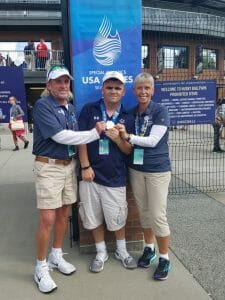
Michael and Nancy Howard, coaches with Special Olympics Florida, accompanied Frankie Jaruszewski to the Special Olympics National Games in Seattle in 2018, where he won a gold medal in bowling.
Nancy and Michael Howard, who live in Palm Beach County, have volunteered their time as Special Olympics coaches for 12 years, and they don’t plan to stop anytime soon. Unlike many coaches, the Howards are not the parents of a Special Olympics athlete. Nancy is a special education teacher at a school that decided to create a Special Olympics team. “Team Howard” participates in bowling, basketball, track, surfing, softball and has started open-water swimming.
Michael, a recently retired inspector for Palm Beach County, has been volunteering alongside his wife.
“If you spend about 15 minutes with these kids, you’re hooked, and that’s what happened to me,” says Michael. “It’s a lot of work, but when you see these kids’ faces, it’s worth it.”
The work is considerable. The Howards arrange and run all practices. If athletes don’t have a ride, they pick them up and take them home afterward. If they lack the proper clothing or equipment, the couple finds a way to provide them. The Howards also strive to schedule extra time for the athletes to socialize with one another, as well as time for their parents to socialize.
The couple even travels, at their own expense, to out-of-town regional, state and even national competitions, a gesture that means everything to athletes whose own parents cannot attend.
Nancy agrees that the volunteer work is gratifying. “Maybe an athlete couldn’t dribble last year, but this year, they can dribble and maybe even make a basket or two. It’s not about the sport in most cases; it’s about the relationships they build with one another,” she said. “It also gives the parents some respite – they know their children are taken care of by us.”
Although the COVID-19 pandemic added even more tasks, such as taking temperatures and extra measures to ensure social distancing at both indoor and outdoor activities, the Howards took it in stride.
“We can’t imagine not doing this,” said Nancy, “People talk about moving away when they retire – we can’t. If we left, these kids would lose out on their Special Olympics team, because I don’t know who would step up to take our place.”
Logan Alvarez, on the other hand, is a volunteer at the very beginning of his adult life and career.
Logan is just 18, but he’s been volunteering with Special Olympics Florida in Miami-Dade County since he was only 7.
“My mom is a teacher and she coached a Special Olympics team,” says Logan. “I would attend state games and local games and I would hand out lunches and help in any way I could. When I got to high school, I trained as a Unified Special Olympics team, where athletes with and without disabilities play on teams together. Logan also helped host basketball and softball skills training events for Special Olympics participants.
“I believe that the world needs a lot more inclusion,” says Logan, who is now a freshman at Florida International University, studying political science and pre-law. “I want to become an ambassador for Special Olympics.”
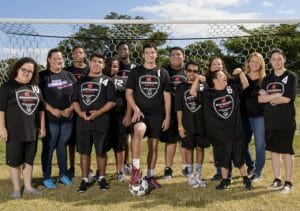
Logan Alvarez (center, with foot on soccer ball) poses with triumphant Special Olympics soccer players in fall 2019, after Miami Southridge Senior High School was named an ESPN Top 5 Unified National Banner School.
Logan, who is not disabled, and in fact was a stand-out high school football player and class president, is highly aware of how difficult acceptance can be for those who with special needs. It’s what makes him passionate about what he calls the “race for inclusion.”
“Just seeing how happy the (Special Olympics) athletes get and seeing them being included is worth everything to me,” says Logan. “In society, you see how left out they are.”
COVID-19 prompts new programs
Special Olympics Florida stepped up throughout the state after the COVID-19 pandemic forced in-person sports programs to be temporarily suspended by hosting multiple virtual programs that encouraged athletes to remain healthy and fit.
At least eight separate programs succeeded in conducting more than 4,900 virtual screenings across all Healthy Athletes disciplines, according to Jim Stratton, communications director for Special Olympics Florida.
For example, a series of videos called “Fit 5 Like a Pro” features both Special Olympics and professional athletes, who encourage viewers to exercise five times per week, eat five fruits and vegetables daily, and drink five glasses of water a day.
“We piloted a virtual screening program for Special Olympics International, using Zoom to connect athletes with medical professionals who answered questions and discussed any health concerns the athlete had,” said Stratton. “We used social media and Zoom to conduct weekly emotional wellness sessions, organize fitness challenges, offer nutrition tips, share healthy recipes, and play games. The sessions provided valuable information but, just as importantly, helped our athletes and their families feel connected during a time when many were limiting their social contacts.”
Laureus Uses Sport to Serve Youth, Bridge Divides and Bring Communities Together
In Atlanta, Ga., youth in underserved neighborhoods just blocks from where the Atlanta Hawks basketball team plays can learn about the sport while being mentored in healthy lifestyles, exercise and social skills, thanks to a local program called Hoops University.
In Kenya, Africa, an initiative called Boxgirls teaches girls and young women up to age 23 the sport of boxing – giving them self-defense skills as well as a feeling of empowerment to succeed in a male-dominated society.
Both initiatives are among more than 200 sport-related programs in 40 nations that receive funding through Laureus Sport for Good, a global charity that works to address violence and discrimination affecting disadvantaged youth. Laureus Sport for Good was founded under the patronage of the late Nelson Mandela, president of South Africa from 1991-’97, and a lifelong philanthropist and activist against racism.
“Globally, we’re working to tackle violence, discrimination and disadvantage through the power of sport,” says Adam Fraser, Chief Executive of Laureus globally. “Programs in South Africa use surfing to provide mental health therapy sessions for kids with trauma; programs in favelas in Brazil are using soccer to bridge the divide between different gangs,” said Fraser. “It runs the gamut in terms of sports being used and problems being addressed. We’re trying to support local community grassroots organizations to empower them.”
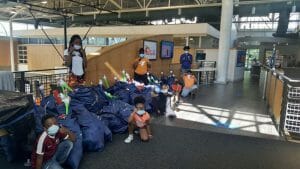
Laureus Sport for Good Atlanta has collected $25,000 worth of high-quality sports clothing and equipment to be distributed to disadvantaged kids to encourage healthy sports activities during the 2020 pandemic. Volunteers spent days sorting, packaging and delivering the special “summer kits.”
Regardless of the sport or location, Sport for Good programs rely on dedicated volunteers.
Many volunteers have personally experienced the benefits of playing sports as a child or teen and are now using the organizational and leadership skills they’ve honed as adults to bring sports opportunities to disadvantaged youth.
For example, Tarin Berry has a career as director of operations at the metro Atlanta YMCA. As a volunteer member of
, which includes 10 other passionate community leaders working to solve local challenges collaboratively, Tarin helps to match community youth programs with high-powered supporters in the form of corporate executives or professional sports teams.
“I’ve developed professional relationships with all of the professional sports teams in Atlanta for the Y, and I’ve continued those relationships, so when it came to do the (volunteer) work with Laureus, it was such an easy fit and so easy to pick up the phone and call on them for resources,” said Tarin. “A lot of what I bring to the table is project management and keeping things on task.”
Even though Tarin is also a busy mother of four, she volunteers for Laureus because sports made “a huge difference” in her own life. She grew up in a family that moved across the country often. “Sports was the one constant,” she says. “I could go anywhere and pick up a softball and fit in. I was never amazing in sports, but it gives kids confidence, the ability to work with a team and a sense of achievement. I can’t even imagine where I would be, even in my professional life, if I had not had the experience of playing sports while growing up.”
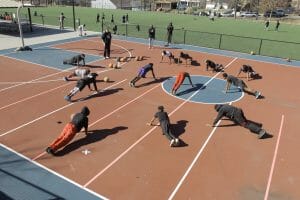
La’Teef Pyles and participants in Hoops University, a community group he runs in downtown Atlanta which is supported by Laureus Sport for Good.
On the other hand, La’Teef Pyles, who serves on the same leadership council, is more hands-on when it comes to helping kids play sports. He leads one of those grassroots neighborhood groups for underserved youth that is now receiving financial support from Laureus Sport for Good.
A barber by profession, La’Teef lives and operates his business in downtown Atlanta. He started Hoops University to teach local kids to play basketball, while working in lessons about healthy living.
La’Teef said he’s grateful for diverse training in coaching, mental health and fitness that Laureus Sport for Good has funded.
“I’m obsessed with basketball – I would teach anybody,” says La’Teef. But he’s especially proud to be called “Coach” by kids in the immediate neighborhood, which reminds him of the South Side Chicago area where he grew up. His parents wanted to be sure he had good influences in his life, and he strives to be that good influence for others.
Adapting to the pandemic
When the 2020 pandemic kept basketball participants from gathering at a neighborhood park, La’Teef installed a basketball hoop in his own backyard, where kids can practice in a socially distanced manner. They also get to see La’Teef in his barber shop, meeting more role models among his customers.
“These guys come by here, they subconsciously see a man of color conducting business, responsibly supporting his family and giving back to the community,” said La’Teef.
Meanwhile, Tarin Berry used her connections during the pandemic to help Laureus Sport for Good put together special gift packages of high-quality sports equipment and clothing that were distributed to disadvantaged families along with food donations so that kids could stay physically active, despite the disruption in normal athletics.
Promoting safety beyond COVID-19
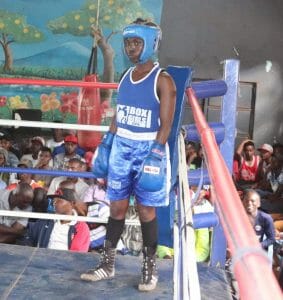
Emily Kasiyoki participates in a national boxing competition.
In Kenya, volunteering led to a paid job at Boxgirls for Cynthia Coredo, who has worked with the organization since 2008. She had experience working with computers and wanted to share her skills for a good cause. She now manages fundraising for the program.
Boxgirls was created when two girls asked to participate in boxing lessons offered by a local boxing coach, Analo Anjere, popularly known as Priest, who was teaching kids in the Kariobangi district of Nairobi, Kenya’s capital and largest city.
Today, Boxgirls also serves girls in rural areas as well as in the city. Currently, about 2,655 girls are enrolled, and the program has an 80 percent retainment rate.
“We use boxing as the entry point to really advocate for girls’ empowerment,” said Cynthia. “We believe it’s very important to be change agents to give girls and young women a voice.” In a society where physical and sexual violence against women has become a national crisis, Cynthia says it’s important to emphasize the ideology that women deserve an equal chance at an education and have a right to a safe life. In addition to learning boxing and participating in tournaments, girls are given leadership mentoring, reproductive education and practice in running a small business, for example, the group makes and sells handbags.
Volunteers work with the girls, but also reach out to parents and schools, to raise enthusiasm for helping the girls to succeed and encouraging them to stay in school and also participate in the Boxgirls training sessions. “We use them as a point of contact in the schools,” said Cynthia.
At least one girl who went through the Boxgirls training has been so inspired that she is now volunteering as a mentor to other Boxgirls participants, encouraging the next generation to become adult leaders and coaches in the program.
To learn more about Laureus Sport for Good, visit