Beyond the Thank-You: Building Volunteer Recognition That Sustains Engagement
National Volunteer Week and Global Volunteer Month give us an important opportunity to celebrate volunteers and their power to tackle society’s challenges.
But celebration alone is not enough. Organizations that sustain volunteer engagement over time understand that recognition and appreciation are not extras layered on after service happens, but are embedded throughout the volunteer experience. When done authentically and intentionally, they strengthen volunteer engagement, deepen belonging and help scale impact.
Research reveals that recognition requires more than a one-time event or thank you. The National Council for Voluntary Organisations found that feeling recognized enough, a culture of respect and trust, and the sense that one belongs were the top three factors influencing satisfaction among volunteers. In Volunteer Canada’s 2013 Volunteer Recognition Study, 80% of volunteers stated they would like to be recognized or thanked by hearing how their work has made a difference. Close to 70% stated they would like to be recognized by being thanked in person on an ongoing, informal basis.
Both studies underscore the importance of recognition and appreciation in the volunteer experience.
Defining Volunteer Recognition and Appreciation
So, what is the difference? Appreciation is the ongoing practice of helping people feel seen, heard and valued. It affirms volunteers for who they are, not just what they do. A culture of appreciation is something that people feel. Recognition is the system that names contributions, connects them to impact and creates opportunities for belonging and growth. It is the structure and practices that reveal and sustain culture.
This expansive approach to volunteer recognition and appreciation does more than say “thank you” and “congrats!” It builds the conditions for people to stay connected, deepen their commitment and inspire others to serve.
At its best, recognition highlights what volunteers have done and—importantly—why it matters. Recognition tells volunteers that their work and the impact it had are seen and valued. Appreciation tells them they belong and their involvement matters to the team.
Telling the Volunteer Story
Storytelling is a powerful recognition tool that can be leveraged to help shine a light on the volunteers, their work and its impact. It’s one of the reasons Points of Light acknowledges a Daily Point of Light honoree, including its 8300th honoree, Gavin Reddy. Through EMPWR, Gavin is helping Native youth and families build healthier habits through culturally rooted cooking and nutrition education. That translates into dozens of families who now have access to fresh, free produce along with support for healthy habits.
The significance of recognizing volunteers like Gavin Reddy is not just a spotlight alone but the way recognition helps volunteers feel that their work and impact are truly seen.
At Points of Light, we know that meaningful volunteer recognition is rooted in authenticity and a clear connection to impact rather than formal banquets or public fanfare. We see how appreciation cultivates relationships and connection.
By fostering a culture of gratitude that consistently appreciates and recognizes volunteers, we strengthen their connection to our mission and community. What’s more, we increase the likelihood that they will continue to show up, stay engaged and grow with us.
Top 12 2026 Nonprofit Conferences to Attend
Going to nonprofit conferences is one of the best ways to keep up in the changing world of social impact. Whether you lead a nonprofit organization, coordinate volunteers, raise funds or work in CSR, these events provide useful insights. They also offer networking opportunities and tools to help you grow your mission.
Here are some of the most impactful nonprofit conferences to consider in 2026:
The Points of Light Conference is our flagship event, bringing together nonprofit professionals, corporate leaders, educators, government officials and civic innovators from around the world. Focused on advancing volunteerism and civic engagement, the conference offers more than 70 sessions, hands-on workshops and networking opportunities designed to inspire action and strengthen communities. We may be a little biased, but in a 2025 comparison of similar nonprofit leadership conferences, ours stood out for offering the best value in terms of session volume, cross-sector collaboration and practical takeaways. It’s a space where ideas are exchanged, partnerships are formed and real-world impact begins.
The Corporate Volunteering Summit for Nonprofits is the Double the Donation team’s premier event dedicated to unlocking new revenue streams and long-term value through corporate volunteerism. As a fully virtual experience, it delivers high-impact strategy prioritizing the financial ROI of volunteer time. More than just a learning opportunity, this summit is a tactical planning session for organizations ready to operationalize their corporate engagement and scale their resources.
The Nonprofit Technology Conference is an annual gathering for those dedicated to positive social change through skillful and equitable technology use. Attendees learn essential nonprofit technology best practices and connect with a like-minded community. The NTC fosters community through networking opportunities, promotes knowledge growth via formal sessions and informal sharing, prioritizes equity through initiatives like racial affinity spaces and accessibility focus, and provides inspiration through keynotes and reflective spaces.
SXSW is a globally recognized event that brings together professionals from across industries to explore the intersection of technology, culture and social impact. With programming that spans innovation, creative arts, civic engagement and emerging tech, SXSW offers a dynamic platform for learning, networking and collaboration. It’s a hub for nonprofit leaders, entrepreneurs and changemakers looking to stay ahead of trends and drive meaningful change.
The Engage for Good Conference is a premier event focused on corporate social impact, bringing together nonprofit leaders, CSR professionals and business innovators to explore how partnerships can drive both purpose and profit. Held annually in Palm Springs, the conference features inspiring keynotes, tactical workshops and networking opportunities designed to foster collaboration and elevate impact. Attendees gain practical tools and insights on topics like CSR, DEI, ESG and leadership development, making it a must-attend for those working at the intersection of business and social good.
AFP ICON is a multi-day conference offering fundraising training, extensive networking and insights from experts. This gathering of diverse fundraising professionals provides a rich program of educational sessions, workshops and discussions, empowering attendees to learn new strategies, connect with peers and be inspired by industry leaders.
Hosted by Grantmakers for Effective Organizations (GEO), this biennial national conference brings together over 1,000 philanthropic leaders to explore equity-centered, community-driven and systems-informed grantmaking practices. The 2026 theme,
Reimagining Capacity Building: Navigating Culture, Systems & Power
, focuses on transforming philanthropic culture through flexible, reliable funding and inclusive learning. Attendees will engage in peer learning, breakout sessions and community-building activities designed to strengthen the effectiveness of grantmaking organizations.
The Social Innovation Summit is a premier gathering of purpose-driven leaders from across sectors—including Fortune 500 companies, foundations, nonprofits and social enterprises—who are committed to advancing social impact. The 2026 flagship eventwill take place in Atlanta and convene over 1,200 changemakers to explore bold ideas, build transformative partnerships and drive scalable solutions to today’s most pressing challenges. Attendees can expect dynamic keynotes, collaborative sessions and networking designed to spark action and innovation.
The NIO Summit is a high-energy conference designed for nonprofit fundraisers and digital marketers. Known for its immersive and creative atmosphere, the event blends timeless fundraising principles with modern strategies, donor psychology and emerging technologies. Attendees can expect dynamic workshops, engaging presentations and interactive experiences that challenge conventional thinking and inspire innovation in donor engagement and retention.
Funders, founders and representatives from philanthropy, government, education, media, finance, science, faith-based organizations, NGOs, creatives, nonprofits, community leaders and more will unite to drive meaningful impact.
Social REV LIVE is an immersive, two-day learning experience designed for social impact professionals and volunteer leaders who are part of the Social REV community. Centered around the Transformative Approach, the event blends professional development with hands-on service, allowing participants to immediately apply what they learn through community volunteering. It’s a unique opportunity to grow leadership skills, deepen program impact and connect with peers in a collaborative setting.
Hosted by Independent Sector, the Upswell Summit is a dynamic gathering of changemakers, nonprofit leaders, philanthropists and civic innovators committed to advancing equity and social good. The event offers a mix of thought-provoking keynotes, collaborative workshops, and community-driven conversations that explore the most pressing issues facing the social sector. With a focus on inclusion, innovation and impact, Upswell provides a platform for bold ideas and transformative action.
Why the Points of Light Conference Stands Out
With so many strong options among nonprofit conferences in 2026, choosing where to invest your time and resources can be challenging. What consistently sets the
apart is its breadth of perspectives and its focus on civic engagement as a unifying theme across sectors. While many conferences specialize in a single area—like fundraising, marketing or technology—Points of Light brings these threads together, offering a holistic view of how volunteerism and community leadership can drive meaningful change. It’s not just about learning new strategies; it’s about connecting with a broader movement. As you plan your year of professional development, we hope you’ll consider
The Voices That Matter Most at the 2025 Points of Light Conference
Real People. Real Impact. Real Conversations.
At the Points of Light Conference, we know that the most meaningful insights often come from the people who are driving real change every day. This year, we’re centering the voices of the do-ers—the nonprofit leaders, corporate social impact professionals, volunteer managers and community advocates who are at the heart of the work.
As social impact leaders face uncertainty and evolving expectations around their work, the Points of Light Conference will connect you with those on the frontlines who are navigating these challenges and finding innovative ways to do the work, motivate their teams and more.
Here’s what you can expect:
✅
Over 70 Workshops
led by practitioners tackling today’s most pressing challenges, featuring speakers from:
L.A. Works
Minnesota Alliance for Volunteer Advancement (MAVA)
to help you go deep on the topics that matter most to you.
✅
Actionable insights
from people who are truly making an impact in communities.
✅
Opportunities to connect
with fellow attendees who share your passion for social change through structured networking.
If you’re looking for inspiration, practical strategies and a network of peers who truly understand the work you do—
to highlight the professional development, networking and industry insights you’ll gain—making it clear why this is a must-attend event.
Plus, you can stretch your budget and stay near all the conference activities by booking your room at our official hotel, the New Orleans Marriott.
for an unforgettable gathering of nonprofit, government, national service, faith-based and corporate leaders driving volunteerism and civic engagement worldwide. This year, we’re introducing six distinct learning pathways designed to meet you where you are—whether you’re looking to strengthen community partnerships, spark new ideas, or take your impact to the next level. Get ready for bold conversations, cross-sector solutions, and actionable strategies to create real change!
Learning Pathways
70 Workshops over Six Learning Pathways
Creating Transformational Volunteer Programs
Explore tactical strategies for: shifting from transactional to transformational volunteer programs, recruiting and retaining volunteers across generations, and addressing challenges in response to evolving volunteer motivations.
Uncover key volunteer recruitment trends, marketing practices and conversion benchmarks.
Empowering Community-Centered Volunteerism
Explore the role of community in creating models of volunteerism that prioritize collaboration, respect for local knowledge and sustainable impact. Learn how to engage your community to play a central role in the design and implementation of volunteer programs.
Workshop Preview | Community-Centered Volunteer Impact: What Matters to Those Closest to the Mission
With Sue Carter Kahl, Volunteer Commons
Discover how prioritize and track what matters to the community those closest to your mission.
Mobilizing the Next Generation of Volunteers
Gain insights into Gen Z and Gen Alpha’s motivations, preferences and barriers to service. Workshops will focus on youth-centric volunteerism, offering perspectives directly from youth and exploring how volunteerism in schools can inspire the next generation of leaders.
Workshop Preview | Youth at the Table: Redefining Leadership in Volunteerism
With Sonali Ratnasinghe, Youth Ambassadors of Service
Move beyond tokenistic youth involvement and learn ways to foster genuine intergenerational collaboration in volunteerism.
Unlocking Revolutionary Employee Engagement
CSR professionals will explore strategies to align social impact with business goals while collaborating with HR, DEI, ERG and ESG leaders. Through engaging discussions, they’ll discover ways to foster employee belonging, boost retention and connect their workforce to the communities they serve.
Workshop Preview | Lessons in Building an Inclusive Employee-Centered Engagement Program
With Lindsay Mason and Stephanie Meredith, Liberty Mutual Insurance
Find out how Liberty Mutual Insurance promotes an egalitarian culture of philanthropy that meets employees where they are while elevating the business value that comes from community engagement.
Reigniting National Service
There are many forms of service – from running for office, to serving one’s country through military service, to serving others as part of AmeriCorps, Peace Corps or National Citizen Service. Globally, national service is essential to meet the changing needs of today’s community leaders. Explore how these programs are evolving to provide flexible, skills-based opportunities that align with values, drive social change and serve as pathways to the workforce.
Workshop Preview | Creating a Community Strategy to Cultivate Volunteerism and Civic Capacity
With Analise Gammel and Samantha Lukasiewicz, Serve Virginia
Learn actionable community strategies to increase volunteer engagement and empower your community to work towards long-term transformation.
Fueling Organizational Growth
Discuss challenges and discover proven solutions for increasing organizational effectiveness. Explore solutions to strengthen partnerships, develop leaders, drive innovation, generate powerful storytelling and diversify funding. Learn how AI is transforming the sector by streamlining operations, amplifying impact and enabling data-driven decisions that advance volunteering and civic engagement.
Workshop Preview | A Quality Pipeline for Volunteering
With Terri O’Brien, Volunteer Ireland
Examine how systems can be implemented across diverse non-profits to enhance volunteer impact, organizational effectiveness, and the overall quality of volunteering.
if you register five or more team members from the same organization!
Stretch your budget and stay near all the conference activities by booking your room at our official hotel, the New Orleans Marriott.
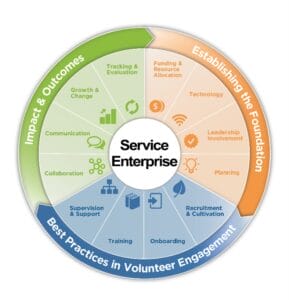
and Points of Light, with training and implementation partners nationwide. However, the true path to successful, enduring change lies in engaging the community — activating the community to fight for causes they care about, share their skills and lived experiences, and build a stronger sense of community.
Intentional community activation is about recognizing and valuing the role of community members in mobilizing and deploying their assets. They are the key to overcoming the issues their neighbors or themselves face, making them an integral part of the Service Enterprise process.
Throughout the curriculum and coaching, organizations focus on working with their community to make positive change instead of working for them. Words matter; intentionally inviting the community to volunteer with — not for — an organization, or exploring community solutions with — not for — the community creates a more equitable power dynamic and helps keep the focus centered on the community and the cause.
Ways Service Enterprises Take a Community-Centered Approach to Mission Delivery
United Way of New Bedford embodies this community-centered approach by having volunteer committees representing the communities they serve as donors and benefactors. Community members are actively involved in the design of volunteer opportunities and program delivery models.
ReEstablish Richmond relies on strong community partnerships to create a welcoming and inclusive environment for newcomers. What helps their collaborations thrive is clarifying roles and responsibilities so that community partners, volunteers and staff know how each other contributes and how they can ask each other for support when needed.
Willis Dady Homeless Services believes all volunteerism should be mutually beneficial. To that end, they help the community connect with established volunteer opportunities and welcome community members to share their insights and services to meet the community’s and client’s needs.
About AL!VE’s Service Enterprise Program
This organization-wide change management program engages a cross-functional team to transform how an organization sees, values and utilizes community members as volunteers. No matter the organization’s size or style, the Service Enterprise Training & Implementation Partners can meet organizations where they are and help them more strategically engage volunteers. We have seen success with hospitals, government libraries with unions, organizations with no paid staff or less than 1 FTE, and more. To learn more about delivering this program or having your organization join the movement, contact AL!VE’s National Service Enterprise Administrator, Kayla Paulson, at
3 Ways Nonprofits and NGOs Can Build Resilience in the Face of Disaster
Climate change, along natural and human-made disaster, are revealing the pressing need for communities to become adaptable and innovative. Their growing frequency and intensity are going to demand that the role of nonprofits and non-governmental organizations (NGOs) evolve so that a disaster recovery plan f becomes best practice for every organization. And that ideal holds true, even for organizations with missions that don’t center on disaster preparedness or response. These organizations are being increasingly confronted with the need to pivot and incorporate comprehensive disaster response and recovery considerations into their work, regardless of whether disaster management was initially meant to be a focus or not.
This blog, the final installment in our series around
, explores the interconnectedness of climate change, natural and human-made disasters, and nonprofit and NGO disaster preparedness and response. It sheds light on the urgency of transformation and the far-reaching implications adaptability holds for our collective future, both for communities and the nonprofits and NGOs that serve them.
Climate Change: A Driving Force for Adaptation
Climate change is increasing the frequency and severity of disasters worldwide. Between 2030 and 2050, the
says climate change is expected to cause approximately 250,000 additional deaths per year from malnutrition, diarrhea, malaria and heat stress alone. Areas with weak health infrastructure will be the least able to cope without assistance to prepare and respond.
Recently, wildfires have ravaged Canada and Hawaii, and a 6.8 magnitude earthquake has devastated Morrocco, taking the lives of thousands and leaving survivors and local NGOs to pick up the pieces. In the wake of this devastation, the beacon of hope remains responders whether volunteers or advocates who are focused on rebuilding communities.
Lori Shinton, president and CEO of HandsOn Nashville, remembers her first experience as a new leader with no disaster response experience and the lessons she learned along the way.
Nashville had spent 10 years relatively free of large-scale disaster. HandsOn Nashville recognized that it would be expected to respond if disaster struck, but planning around preparedness and response was on the back burner. And then on March 3, 2020, a tornado struck the city and left widespread damage.
“Our team responded, but we built the plane while we were flying it,” she said. “The result? Staff worked long hours, they were frustrated with the confusion of figuring out what we should be doing, and we were learning in real time about secondary trauma of responding to the disaster.”
A few weeks later, the COVID-19 pandemic began, and the U.S. followed many parts of the world that were already shut down. HandsOn Nashville continued to respond, along with other NGOs in the community. And while the world was learning to live with mitigation measures around COVID, HandsOn Nashville was still actively responding to the tornado. Then, in December, a bomb was set off in downtown Nashville, prompting the necessity of further yet differing responses needed. A few months later, a flash flood struck the city and impacted nearly the same number homes as the tornado. Finally, another tornado wrought localized damage.
“We learned that focusing on preparedness and developing a well-defined emergency response plan was the only way to care for our team and have them prepared for whatever may happen,” recalled Shinton. “We focus on training — quarterly at least — and we have been able to test it in exercises and feel as prepared as we can.”
Being prepared now ensures the community the best services possible while protecting responders from burnout.
, is a resource that offers insights and strategies to empower you to take action before, during and after a disaster. You’ll also learn how to be an advocate for those affected by disasters.
made possible in partnership with The Allstate Foundation, and created by Points of Light.
Beyond Core Mission: Tailoring Services
Nonprofit and NGO leaders know that being adaptable is a key component of success. As natural and human-made disasters become more commonplace, it’s increasingly important to tailor services to address immediate community needs as disasters unfold.
For community leaders who want to find ways to tailor their organization’s response to community needs during disaster, start small by assessing your organization’s strengths. Develop a written plan leveraging those strengths, recognizing that it’s easier to change a plan than to create one in the midst of responding to disaster. Use existing data from trusted sources, like
, to understand the vulnerabilities in your local community.
Often, the most valuable input comes from the community itself. For example, when the COVID-19 pandemic began, the
was forced to shut its doors. Overnight, it went from a buzzing community gathering space to empty and whisper quiet.
Its mission had always centered on providing access to safe, innovative, learning and play experiences, but now that it couldn’t deliver on in-person experiences, the pivot had to be quick and decisive. By being willing to shift its mission and prioritize the community’s needs, leadership moved immediately to supporting children and families by providing engaging virtual play activities and mental health resources. They partnered with
that addressed the mental health of parents, caregivers and children through the lens of trauma caused by a pandemic.
“As a nonprofit that prioritizes working alongside the community, it is valuable for us to be nimble and be able to move quickly. We did this during the pandemic by having an overall objective to give parents and caregivers support during very uncertain times,” said Tifferney White, CEO of Louisiana Children’s Museum. “While many places were shuttered, we were able to provide no-cost, easily accessible resources, including early learning play opportunities, ideas that parents and caregivers could do at home, and nature walks to name a few.”
The museum also experimented with using its 8.5 acres of indoor and outdoor space in collaboration with a local public school, allowing the school to move its prekindergarten and kindergarten classes to their facility. The school was able to continue in-person learning while having the space it needed to socially distance students in a safe and engaging environment. The result was that the museum furthered its mission of having memorable and valuable learning experiences in safe spaces for children while serving its community in new and innovative ways.
Collaborative Partnerships for Effective Response
Disaster preparedness and response experts understand the power of collaboration. Capacity grows exponentially when foundations, faith-based organizations and nonprofits join forces.
That’s a big reason why, in the U.S., Voluntary Organizations Active in Disaster (VOADs) are such an integral part of disaster response. VOADs are a collective of faith-based, community-based and other non-profit organizations that band together to form a cooperative that centralizes communication, coordination and collaboration. By centralizing these efforts, VOADs foster more effective delivery of services to communities affected by disaster.
has its own.
National Voluntary Organizations Active in Disaster was established in 1970 in response to Hurricane Camille, a category 5 storm that hit the Gulf Coast in August of 1969. At the time, private sector and nonprofit organizations served disaster survivors independently of one another. As a result, the way survivors received help was decentralized and inconsistent. Since then, the organization has facilitated 48,129,263 volunteer hours from 9,907,071 volunteers and fielded $1.3 billion in donated labor to response and recovery efforts across the United States in 2019 alone.
“Every community does indeed need to be prepared,” said Chris Cameron, executive director of HandsOn New Orleans. “It looks like preparedness at every single level, with elected government officials, corporate partners, it’s going to require faith-based institutions.”
All disasters begin and end locally, and disasters exacerbate preexisting conditions during a time when typical operating policies and procedures are overwhelmed and communities may be traumatized. Taking a whole-community approach underscores why partnering leads to better, safer and faster outcomes.
Building a Comprehensive Disaster Response Approach
When they Ukraine war broke out in February of 2022, many NGOs in surrounding countries had little to no experience in disaster preparedness, response and recovery. Agnieszka Lissowska-Lewkowicz, president of Polish NGO
affiliate remembers a steep learning curve in figuring out how to best support the 1.5 million people displaced by the war, streaming across the border to safety.
“Refugee work is definitely long-term approach. It requires money, administration, specialists, space,” said Agnieszka. “We had to decide, ‘Are we able to make this effort. Are we able to start a new type of work, activities, help, projects to our organization and manage it [long term]?’ Our decision has to be wise, serving not only the refugees, but first of all our organization. And it has to be realistic. And we see the very deep sense of this.”
Centrum Wolontariatu recognized that, for Ukrainians who stayed in Poland, the organization would need to offer long-term, comprehensive support. Effective help would have to extend beyond basic needs, like food, shelter and clothing, to include assimilation into the new environment through work, education and psychological support. That comprehensive approach required cooperation between different organizations, and the most important resources were people and time.
“People to organize help, to do extra work. Time to get knowledge, to organize help, time to get additional funds,” she explained. “When the war began no one expected it, no one was prepared to host hundreds of thousands of Ukrainians, and only few Polish organizations were working with migrants before. It was shock for all of us, but we all did our best.”
Calling Social Impact Leaders
The 2024 Global Summit on Social Impact is a premier event taking place in Warsaw, Poland, February 7, 2024. It brings together companies, nonprofits and NGO’s from around the world that are passionate about volunteerism, civic engagement and social change.
The interplay between climate change, natural and human-made disasters underscores the critical need for nonprofit and NGO organizations to embrace a holistic disaster response approach. Disasters can strike at any time, demanding adaptability and innovation from even those whose missions don’t initially revolve around disaster preparedness.
Whether responding to human-made disaster, like war, or natural events, like wildfires, flash floods and hurricanes, nonprofits and NGOs will need to remain flexible in how they respond. They’re being called upon to begin to prioritize disaster preparedness and community response strategies, from investing in training to forming partnerships to tailoring services to meet immediate needs. By shoring up preparedness and response planning, organizations will become more nimble and be best positioned to contribute to the resilience and rebuilding of the communities they serve.
The Role of Volunteers in Humanitarian Disasters: Insights from the IAVE Forum
As I stepped into EDP’s Portugal headquarters to join International Association for Volunteer Effort’s (IAVE) forum on the role of volunteerism in humanitarian disasters, I was greeted with a hug from a stranger. IAVE GNVL European Regional Coordinator Sonia Fernandes with Social Entreprenu Pista Magica excitedly shared her memory of learning from Points of Light twenty years ago, an experience supported her in creating a school of volunteering in Portugal.
I was humbled to see that the day kicked off grounded in the underpinnings of Points of Light’s mission to equip, mobilize and inspire. IAVE CEO and host of the convening Nichole Cirillo reminded the crowd that, “…as disasters continue with greater frequency and impact, we need volunteers in all three of the disaster phases, and in particular, in building the systems and mechanisms for recovery.”
The day’s work centered on the role of volunteers in response to the war in Ukraine. Iulia Barbanegra of Moldova Volunteer Center detailed the multi-faceted actions put together to support the 100,000 refugees who flowed immediate into Moldova following the beginning of the war. The team put together a hotline, a call center and structures for humanitarian aid that included border checkpoints, accommodation centers and education activities. MVC quickly sorted volunteers into areas of the greatest need even as they were fielding calls from across Europe from people who wanted to help.
“We didn’t have housing, even for Moldovan volunteers, let alone others,” she recounted. “Some of the refugees were angry, and of course, they have a right to be angry, but we had no time to train [our volunteers] on how to handle.”
The increasing necessity of preparing volunteers, both mentally and physically, in addition to the burden placed on volunteer centers, would emerge as a thread through the day’s conversation.
Dr. Amjad Mohamed Saleem, manager of volunteering, youth and education development from International Federation of Red Cross and Red Crescent Societies, shared the words of a Red Cross volunteer: “Kindness and humanity are superpowers.” Those words reminded me of the importance of the different elements of the Points of Light Civic Circle®. Are volunteerism and service pivotal change-making vehicles? Yes, but so is the act of building resiliency. Dr. Saleem continued to share that, despite what may appear as an overwhelming need, the first action of the Red Cross is to prepare volunteers vs. jumping into action.
I watched as heads nodded in the room with a shared understanding that, without proper training and mental health support, volunteers can ultimately become added challenges themselves within a disaster site.
There is a constant push and pull between the volume of interest from spontaneous volunteers and a need for formalized programs with trained volunteers. The Civic Circle offers much-needed options for those who “just want to help” by creating pathways to listening and learning about a cause area, using their voice to amplify stories of those impacted, and donating funds to support recovery.
If an organization as well supported and well established as the Red Cross can’t support the influx of interest from volunteers, there is a clear necessity to offer a greater diversity of ways for people to engage and become part of the solution.
As we moved from response to resiliency, I anticipated we would focus more on infrastructure and less on the necessity of training, but I was wrong. Increasingly, humanitarian volunteering comes with risk. Over the last year, there were over 300 deaths of volunteers as recorded by Medicos do Mundo. The single greatest risk for volunteers is a lack of formalized training before engagement. Marcio Silva shared Medicos do Mundo’s model of training which begins with “While I’m delighted you dreamed as a little girl to go as a first responder to a disaster site, you’re not cleared as you’re not trained.” Medicos do Mundos has put together an emergency volunteer training module that aligns skill sets with needs. They assume the necessity of skilled-based volunteering.
“You can’t run an emergency response without resources or communications,” Silva said, noting that intentionally keeping infrastructure supports apart from operations is a recipe for failure. There remains an increasing need to harness the energy and passion of those who want to volunteer in other ways. Points of Light’s Civic Circle offers that roadmap for a wide array of engagement strategies.
Executive Director Wolfgang Krell of Augsburg Volunteer Center shared how his organization had delineated the idea of formal and informal volunteering due to the necessity of volunteer centers responding to spontaneous disaster volunteers in a way that harnesses and focuses energy.
“Expectations need to be checked as we have volunteers that want to change the world in one week, and it is very difficult to do this,” said Krell. “Volunteering makes the world go round, especially in times of crisis.”
We headed into lunch, wrapping up the topic of community volunteers in the disaster preparedness portion of the day with Nicole Cirillo challenging us: “What can we do now? Networks are the key to resiliency. Time and time again research shows that you have a greater chance to survive and thrive as a part of a Network. Her words recalled my own experience with Points of Light’s Global Affiliate Network, a testament to the idea that the most powerful solution to challenges is collaboration.
The afternoon kicked off with Lorrie Foster, director of corporate at IAVE, reminding us that when a disaster strikes, phone ring off the hook with employees asking, “What can we do?” We then had the opportunity to hear from three companies with various takes on volunteer response programs.
“Intervention Model for Emergencies resembles closely the Points of Light Civic Circle as it asks employees to listen, learn, use their voice, be a part of social activation and donate to be ‘better citizens,’” shared Francisco Moro, Fundacion Telefonica.
Moro’s take on skilled based volunteering around disaster work is that this role falls to companies. He emphasized how critical it is that companies provide the technical skills to grow an NGO’s capacities. In other words, a company cannot just be an emergency response vehicle, it also needs to also provide preparedness and resilience support.
The most essential part of disaster response is to react to what people need, not to what you think they need. For example, when the war in Ukraine began, people wanted to send food, but the costs are astronomical to ship food to a foreign company. The true need was funding and monetary donations rather than food.
When disaster strikes, it’s common for people to feel compelled to help, but experienced social impact professionals know the importance of being gatekeepers when it comes to volunteer power. They understand the need to coordinate with first responders and provide the right help at the right time in the right ways — not just from volunteers but expert volunteers who can offer guidance in their core areas of expertise.
Volunteer Engagement Professionals: Take Your Program to the Next Level
. As this program changes hands, Points of Light is partnering with AL!VE to ensure a smooth transition. This is part of a series of updates from AL!VE. This one comes from Service Enterprise Administrator Kayla Paulson and highlights the organization’s work with Service Enterprise.
There is something about the change of a calendar year that helps us reset, refocus and reflect on goals. That’s why
. This change management program empowers organizations to reach new heights in leveraging volunteers and their skills throughout the organization to achieve their social mission.
Almost 10 years ago, when I was part of the team piloting the national rollout of Service Enterprise by Points of Light one of the volunteer engagement professionals in my cohort reflected on the amazing improvements that she made at her previous organization and how things were on a positive trend when she left, but in her absence, they reverted to the old way. Her realization was that she changed her processes, policies and perspectives on volunteer engagement, but she didn’t get the organization to change its culture and the collective way it engaged volunteers. As volunteer engagement professionals we know how to reach volunteers, but sometimes we may try to convince ourselves otherwise — that no organization can have a highly effective and efficient volunteer engagement strategy if it’s solely the volunteer engagement professionals who believe in the power of volunteers.
Service Enterprise is that catalyst for fundamental organizational culture change. It brings together a cross-functional team that is committed to your organization’s mission and maximizing the human capital of the organization. To kickstart the effort, organizations take a multi-person independent self-assessment and debrief the results with a coach to help identify strengths and areas of opportunity, which shines a light on the areas most ripe for change. As a cross-functional team, which includes leadership and volunteer engagement professionals, you attend a multisession cohort-based training program that guides you through conversations and activities that are dedicated to changing the volunteer engagement culture within your organization. During the training and up to a year after, an accountability coach provides support in creating and completing an action plan that will ensure your organization follows through on the changes needed to influence the culture.
Change isn’t easy, but with research-based strategic improvements in your organization’s approach to volunteer engagement, you can have an impact that extends well beyond this calendar year and will have an exponential effect on your organization’s ability to deliver its social mission. If you want to learn more or even add Service Enterprise to your 2023 goals, check out
that dives into the research behind the work as well as the 12 characteristics of organizations that operate as Service Enterprises. You’ll have the opportunity to connect with Service Enterprise Certified organizations, trainers and hubs at the ASC regional conferences this spring and the
in Chicago this summer. You’re welcome to join an AL!VE social and informative sessions, or stop by the information booth. When you are networking at conferences, look for Service Enterprise stickers on name badges so that you can connect with top-tier volunteer engagement organizations. If you can’t make it to a conference, check out our map to find a training hub or certified organizations near you, and make 2023 the year you take your volunteer management program to the next level.
How to Use Your Volunteer Toolkit this Global Volunteer Month
April is right around the corner which means Global Volunteer Month is rapidly approaching. Points of Light wants to equip you with the tools you need to make it a success. Global Volunteer Month is an opportunity to recognize volunteers for the amazing work they do to support your organization as well as make the community aware of your needs and recruit more volunteers or connect individuals to causes they care about. Head over to our
is full of ideas to support your company’s employee volunteerism campaign tactics and plan your Global Volunteer Month activities. We show you how you can best
, share their stories and promote the month internally and externally. It also includes logos and graphics you can use in your communication materials.
also includes logos and graphics to share on social media, as well as a host of ideas as you map out your organization’s plan to participate in Global Volunteer Month. In addition to help with messaging and promoting engagement, we offer recognition ideas that you can carry with you throughout the month and all year long.
Toolkit for Individuals
You don’t have to be part of an organization to participate in Global Volunteer Month. Passionate individuals can shine their light by
includes many of the same elements as the toolkits for companies and nonprofits – a sample communications plan, graphics and logos, and ideas for promotion. It also features ideas for giving a floor speech to honor and recognize the constituents and organizations making a difference in your community.
No matter who you are and how you’re getting involved this year, start now to map out a plan for your Global Volunteer Month and make an impact in your own community and beyond.
Volunteer Management Best Practices: Tips for Your Nonprofit
come through your doors. Depending on the number of paid staff members you have, managing volunteers can become tricky. After all, you’re juggling different schedules, personalities and needs, all while trying to increase volunteer turnout at your organized events. Points of Light is here to help. That’s why we’ve put together these volunteer management best practices to
reigns supreme, nonprofit marketing doesn’t have to rely on internal staff alone. Call on your supporters and volunteers to spread your message, like promoting your annual toy drive or
and hone all of your external communication into a cohesive and unified effort. If you don’t yet have a marketing liaison or team to strategize around your content, consider establishing positions for this effort alone. And if you don’t have the capacity or budget, consider engaging a
from your stakeholders and communicating openly with them. First, you’ll need to understand the interests, challenges and values of each group, then address them with authenticity and transparency. Ensure that you have ongoing dialogue with all parties involved in your organization. Seek to understand where they’re coming from, and consider how you can bridge any gaps in trust through communication about your efforts.

 Creating Transformational Volunteer Programs
 Empowering Community-Centered Volunteerism
 Mobilizing the Next Generation of Volunteers
 Unlocking Revolutionary Employee Engagement
 Reigniting National Service
 Fueling Organizational Growth