“Youth Can Lead Now”: Jen Landers on Building a Culture of Service in Colorado
Jen Landers has spent the last seven years helping high school students discover something many adults still struggle to believe: they already have what it takes to lead.
As executive director of
. CYL empowers teens to lead with courage and kindness, take action on issues they care about, and shape their communities with purpose.
But for Jen, this work isn’t just organizational—it’s deeply personal.
The Challenges Young People Face
“The young people in our community are navigating growing mental health challenges,” Jen said. “They’re navigating increased social isolation and lack of meaningful opportunities to connect with others and contribute to something bigger than themselves.”
At the same time, Denver metro communities face challenges that are happening across the country and around the world. Political, generational and cultural divides are making it harder to work toward shared goals.
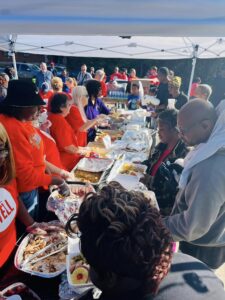
Jen Serving alongside Young Leaders serving a meal to community members in partnership with Break Bread.
“As w
e look at our work, we want to find the intersection between those challenges. We want to figure out how we can really engage youth to feel a sense of belonging in communities, while we give communities the resources and talent of young people to help them solve their biggest issues and take advantage of their greatest opportunities.”
This simple insight, grounded in years of community-building, shapes how CYL works with young people. The organization doesn’t tell students where to serve—it gives them the space to choose, building resiliency, passion and confidence. Whether it’s environmental justice, food insecurity, or mental health, CYL meets young people at the intersection of passion and purpose. That trust not only keeps students engaged, but helps them grow into confident, community-minded leaders.
Learning and Connection Bring Insights for the Future
Earlier this year, Jen traveled to New Orleans for the
—her first time at the international conference where social impact leaders come together. Her attendance was made possible from a scholarship from Points of Light, with generous support from the
. The experience offered more than just inspiration. It provided a critical pause to reflect, connect, and realign.
“Receiving the scholarship for Colorado Young Leaders enabled us to do something that we would not have been able to do,” Jen reflected. “Our budget to participate in things like this is so small, but we recognize that really being able to have access to ideas and best practices is critical for us.”
Young Leaders helping with a diaper drive for new parents in partnership with WeeCycle.
For an organization at a key point in its evolution, the timing couldn’t have been better. CYL is currently expanding its reach beyond the Denver metro area with a bold vision: to bring diverse youth together from across Colorado—not just demographically, but across lived experiences, political perspectives, and cultural backgrounds.
“The conference helped reenergize my passion for our mission,” Jen said. “I walked away with fresh insights and practical tools we’re already weaving into our strategic plan—everything from how we train mentors to how we tell our story.”
Jen knows that kind of growth won’t happen in isolation. It will take partnerships, mentorship, and a shared belief across communities that youth-led service is not a “nice-to-have”—it’s essential. That’s the kind of message she brought to the conference, and the kind she returned home determined to amplify.
Today, as she and her team move forward with new tools and deeper clarity, Jen and the team at Colorado Young Leaders remain focused on the young people at the heart of it all. Every program, every decision, every story is about helping them lead—not someday, but now.
How Brilliant Detroit Is Building “Kid Success” Right in the City’s Neighborhoods
. This organization is dedicated to building “kid success,” providing families with children from birth to 8 years old with what they need to be school-ready, healthy and stable. They do this by providing proven programming and support year-round out of Brilliant Detroit homes in high-need neighborhoods.
We recently had the opportunity to speak with Cindy Eggleton, Brilliant Detroit’s CEO and a driving force behind this incredible organization. Join us as we take a peek into the world of Brilliant Detroit, exploring their innovative approach to building kid success, one family and one neighborhood at a time.
How is your organization making an impact?
When we came together eight years ago to create Brilliant Detroit, we began with a question – what can we do to ensure that Detroit children are kindergarten-ready? We knew that the answer began at the beginning. The fact is that 90% of a child’s brain is developed by age 3 and much of their future is impacted by their first eight years of life.
We challenged ourselves to be innovative and explore how we could disrupt the current early childhood ecosystem. Here is what we came up with: Instead of families getting in a car or bus to access help, let’s renovate abandoned homes and offer evidence-based programming right in the middle of neighborhoods. Instead of directing what happens to families, let’s listen and learn and provide programming that families need and want. Instead of creating yet another program, let’s act as a connector and bring together organizations that are addressing different early childhood needs in one warm and safe place. Let’s create “Kid Success Neighborhoods” where families with children ages 0-8 have what they need to be school-ready, healthy and supported.
Brilliant Detroit provides material and programmatic support for literacy growth. Resources are made as accessible as possible through partners such as Little Free Library. Image courtesy Brilliant Detroit.
Tell us about a project or initiative you’re working on right now that’s making a big impact on your community.
This summer, we piloted a citywide literacy initiative called Detroit Reads. The goals of the program were to combat “summer slide” (a loss of academic ability in youth outside of the school year) and build a love of reading in our young children. We served over 300 youth through our daily summer programming, which was hosted at 12 hubs. We had a city-wide men read day, an author day and family health nights, among other things. This is in addition to our specific tutoring and family efforts. Ultimately, we are pleased with the impact of the first summer of Detroit Reads. We look forward to building the program by expanding to more of our hubs and by partnering with other champions of literacy across Detroit.
The Detroit Reads program was a success both on a macro and micro level. Over 30 community partners participated in seven weeks of programming at the 12 hubs. Each location included at least three hours per day (over 3,000 combined hours) of literacy programming, which included small group tutoring, storytelling and read-alouds. Ten young adult interns supported by the Grow Detroit Young Talent Program provided student leadership to youth campers. Students explored improvisation, STEM, nature and gardening through hands-on experiences and reflection activities. Students were able to connect theories and knowledge to real-world situations. Perhaps the greatest testament to a successful pilot was all the smiling faces of the youth we served!
“My favorite moments at Brilliant Detroit are those when I can see the positive change that families are making in their own lives using the resources of our organization. I wake up every day inspired by all the people I get to work with who are moving their lives forward. We see this transformational change all the time. Caregivers join us as participants and then start volunteering their time and skills or join our staff to help spread our mission of ‘Kid Success’ to more of their fellow neighbors. It is truly energizing.” — Cindy Eggleton, CEO, Brilliant Detroit
Do you have an upcoming special event or milestone that your organization is celebrating?
We are looking forward to celebrating a long-coming and major milestone in 2024. Years ago, when researching the potential growth of Brilliant Detroit, it was determined that 24 hubs was the number needed to create population level change in Detroit. In other words, 24 was the magic number where we would start to see the needle move on the statistics that inspired the creation of Brilliant Detroit, namely kindergarten and third grade reading ability, the number of families living in poverty and lack of access to books and childcare options.
What role does volunteerism play in your organization’s overall mission and objectives?
Volunteerism is a huge element of the success of Brilliant Detroit. Many of our programs are fueled by volunteer support, including one of our most impactful programs, high dosage literacy tutoring. Our goal in utilizing volunteers is to further include community in our work and also educate volunteers as to why current conditions exist.
We believe it is important that volunteers understand factors that led to the inequities we see today in Detroit. Volunteers bring a passion and a diverse set of perspectives and experiences to our families. We see working with volunteers as an extension of our value of creating neighbor to neighbor connections.
How are you recognizing and thanking volunteers for their contributions?
We recognize our most dedicated volunteers via social media highlights as well as our “Brilliant People” campaign that spotlights our most dedicated supporters. We also thank our volunteers via swag giveaways and an annual volunteer celebration picnic. We are always happy to verify service hours for our volunteers for awards, including the
What’s one piece of advice you’d give someone who’s looking to get more involved in their community through civic engagement?
So often in social justice movements, people are providing solutions for others and not seeing those people as individuals and embracing their insights. The reality is that people have more to say about what is right for them than we could ever figure out. I always say what is most important is transitioning from listening to talk or to tell, to listening to hear, to learn and then to help do and achieve. You have to first see people for them to grow.
Gertrude’s Garden: An Abandoned Lot Transformed to Vibrant Community Hub
In the heart of McComb, Mississippi, where an abandoned lot once stood, a vibrant community hub has taken root:
. This remarkable transformation illustrates the power of reclaiming neglected spaces and the profound impact that “third places” – spaces beyond home and work where people can connect – can have on community well-being.
Gertrude’s Garden is a testament to the vision and dedication of its founders. What was once an underutilized area is now a thriving space for art, community building and more. Their mission is to provide a safe and enriching environment for residents of all ages
The Garden has become a catalyst for positive change in the Burglund community. In 2023, they hosted their third annual Thanksgiving meal, serving over 200 residents at a warm and festive gathering. Additionally, an art installation named “Directions” now graces the space. This thought-provoking piece seeks to inspire the community’s youth.
Read on to hear more from Kevin Brown, Gertrude’s Garden’s community advocate.
What makes your organization an Impact Icon?
Image courtesy Gertrude’s Garden
Gertrude’s Garden is a re-imagined and re-purposed abandoned lot in the historic Burglund community in Mccomb, MS. The Garden is located betweeen Burglund Heights housing complex and a convenience store. Gertrude’s Garden program includes art, literacy, recreation and community building.
Tell us about a project or initiative you’re working on right now that’s making a big impact on your community.
For our third annual Thanksgiving meal, over 200 residents were served a hot meal. We have also just completed an art installation named “Directions” which depicts the distance to well-known cities and identifies Burglund as the starting point for the journey of any youth of the community.
Community Impacts
The impact of Gertrude’s Garden is tangible, touching various aspects of community life:
Public Safety: Enhanced lighting, a new crosswalk and traffic signs create a safer environment for everyone.
Recreation: A playground, basketball court and other amenities provide much-needed opportunities for play and physical activity.
Social Connection: Community gatherings like holiday meals and formal galas foster a sense of belonging and togetherness.
What role does volunteerism play in your organization’s overall mission and objectives?
Image courtesy Gertrude’s Garden
Volunteerism plays the central role. There is nothing that we can achieve without volunteersism. We are not a nonprofit organization. All of our support comes from small in-kind donors and sweat equity.
How are you recognizing and thanking volunteers for their contributions?
We have a quarterly award certificate program, and we are also a
“A small step in the right direction can create change.” –Glenda Jordan, Gertrude’s Garden
What’s one piece of advice you’d give someone who’s looking to get more involved in their community through civic engagement?
Don’t wait, act! Any service that you can provide is an asset to your community.
Are you a nonprofit leader who is innovating in the social impact space and wants to become an Impact Icon? Answer our questionnaire, and you could be featured here on our blog!
Time Well Spent: Jocelyn Nelson’s Case for Volunteer Time Off
Jocelyn Nelson, director of Corporate Social Impact Consulting at Points of Light, has always had a heart for community service. From being a founding member of Liberation Library to leading the external affairs team at Chicago Cares and now her current role, Jocelyn’s path has been fueled by a deep-seated belief in the power of volunteering. Recently that belief was reaffirmed through her own transformative experiences with Volunteer Time Off (VTO), which shaped her understanding of its potential to benefit both employees and the communities they serve.
Points of Light is proud to offer VTO to all employees, which can be used in increments of either eight hours one day a month, or two hours per week. When Jocelyn joined the organization, she was eager to take advantage of this generous VTO policy. “At Points of Light, volunteerism is the center of our work,” she explains. “To know that we had a significant VTO policy showed me that the company was walking the talk. That policy – coupled with my being a somewhat newer resident of Rhode Island – gave me the opportunity to not only volunteer but also physically connect to the area where I lived. The work I do at Points of Light is very national and global, so getting hyper-local in my personal volunteer work was important to me.”
Jocelyn’s VTO led her to the Social Enterprise Greenhouse, a coworking space and network supporting social impact ecosystems in Rhode Island. Initially hesitant about her ability to contribute, she soon discovered her skills were much needed. “When I met with the volunteer manager there, I kept thinking to myself, ‘Honestly, what do I have to offer small businesses? My background is in nonprofit,’ But I soon learned that my assumptions were false,” she admits. “They were also supporting nonprofits. I learned that helping to organize this incredible network of volunteers was a need I could support by offering a new set of eyes to see opportunities, brainstorm volunteer categorization, define the volunteer pipeline and help build a volunteer engagement strategy.”
This is the work that Jocelyn and her team do at Points of Light every day, as they help enable companies to strengthen their corporate social responsibility and employee volunteer engagement strategy. With Social Enterprise Greenhouse, she realized her career skills were just what was needed for this pro bono volunteer opportunity.
“We mapped the types of experiences volunteers have and Jocelyn was an incredible soundboard in the process,” says Serena Manna, senior manager of Network Engagement at Social Enterprise Greenhouse. “She asks the right questions that help focus the objective – and she’s practical and patient through it all. With her support, there was less rumination on crucial decisions, and we finished drafting an intake form that feels personal and engaging!”
With her own experiences as living proof, Jocelyn firmly believes that companies can reap significant benefits from investing in robust VTO programs. Beyond boosting employee engagement, VTO shows potential and current employees that the company values community involvement. “A VTO policy serves as a signal for folks who are looking to apply for a position that community is a priority and a value for that company,” Jocelyn explains. “Plus,” she emphasizes, “as we know very well at Points of Light, there are incredible mental health benefits that can be experienced in powerful ways through volunteering. Providing a VTO policy encourages and promotes a critical component of employee well-being. So, it’s both a recruitment and retention tool.”
Nonprofits also stand to gain from VTO programs. Jocelyn, drawing from her experience in the nonprofit sector, highlights the year-round need for volunteers. “As someone who has worked at and with nonprofits for 15 years, I can say that nonprofits need volunteers throughout the year – not just during the holidays,” she states. “VTO policies that give employees the flexibility to volunteer when they want really helps meet community needs by supporting organizations that can, in turn, support their communities.”
“Skills-based volunteering brings a different dimension to a nonprofit,” Serena Manna adds. “Caseloads are high and most of the team is dedicated to the day-to-day support and coordinating various opportunities for participants. While we’re able to identify challenges, there isn’t a lot of time for implementing changes.”
In essence, VTO is a win-win proposition. It empowers employees to make a difference in their communities while fostering a sense of purpose and belonging. It also strengthens the company’s bond with the community and enhances its reputation as a responsible corporate citizen. Jocelyn adds, “VTO is also a way to celebrate and maximize the efforts of those who are already volunteering. A lot of what a VTO policy does is support existing behaviors, as well as make those behaviors permissible which, naturally, encourages more volunteering.”
Jocelyn’s passion for volunteerism and her insights into its benefits offer a compelling case for companies to embrace this valuable perk. As she eloquently puts it, VTO is not just about companies increasing their volunteer engagement; it’s about creating a ripple effect of positive change that benefits everyone involved – the employees, the community and the company itself.
If you’re ready to explore how Points of Light can help your organization implement a VTO policy or increase engagement in other ways, watch our latest virtual session “Policies that Enable Employee-Powered Change,” designed for corporate social responsibility practitioners. We’ll explore innovative and proven policies – like Volunteer Time Off – that enable employees to support their communities both during and outside of working hours.
And save the date for the launch of our Volunteer Time Off Learning Brief of Sept. 24!
Shop for Gifts With Impact This Holiday Season at the Daily Point of Light Marketplace
As the holiday season approaches, the joy of giving takes center stage, offering a unique opportunity to share gifts with impact. It’s a perfect time to use your
to further social good. This year, transform your shopping into a meaningful journey, choosing gifts that not only delight your loved ones but also resonate with deeper values of sustainability, community support and positive change.
Welcome to the Daily Point of Light Marketplace – a virtual venue that allows you to shop for products made by
honorees. These social entrepreneurs offer unique products that ultimately better the world through their businesses. You can embrace the spirit of the season by selecting gifts that bring joy to your friends and family, and the world, creating ripples of positive impact that last all year long.
See the full suite of products below and read inspiring stories of how these social impact leaders are driving real and sustained change in their communities. But first, find out what a social entrepreneur is and why this pathway is essential to civic engagement.
What Is a Social Entrepreneur?
Social entrepreneurs are innovative changemakers who establish businesses with the primary goal of addressing social, environmental, or cultural challenges. Unlike traditional entrepreneurs, their primary measure of success isn’t profit, but rather the positive impact they can make on society or the environment.
Supporting social entrepreneurs is crucial because they often tackle issues that are overlooked or underserved by other sectors. By purchasing from or investing in their businesses, consumers and investors not only receive a product or service but also contribute to solutions for pressing global problems, promote sustainable development, and help foster a more equitable and just society. In essence, supporting social entrepreneurs means playing an active role in shaping a better world through mindful economic choices.
Gifts with Impact: The Daily Point of Light Marketplace
Shop ‘til you drop! These Daily Point of Light honorees are offering products through our marketplace that help you become a champion of social good with every purchase.
, transforming adversity into a thriving business that offers custom bowties and champions community causes. Each purchase supports workshops and anti-bullying initiatives. Join Alex in making a difference—one bow at a time.
: Liam Witt’s childhood cancer diagnosis in 2007 propelled his parents, Gretchen and Larry, into action. They initiated a massive bake-a-thon, baking 96,000 cookies to fund research for better, less toxic pediatric cancer treatments. This effort evolved into
, raising nearly $20 million through grassroots events. By purchasing these cookies, you can enjoy or give a sweet treat this season while joining a movement to change the future of pediatric cancer treatment.
, a natural, organic lip balm, dedicating 100% of profits to cancer research and patient care. Their homemade balm has contributed over $43,000 to the cause. By choosing their products, you’re joining the Bennett brothers in their heartfelt fight against cancer.
in their mission to bring relief and unity to families with critically and terminally ill children. Founded by Rodney and Mindy Atwood, who personally experienced the hardships of caring for sick children, Patches of Light offers essential support by covering living expenses and emergency needs. Support this cause by purchasing Mindy’s published books, with all proceeds directly aiding families across the United States and beyond.
is inspired by Natalie’s heartfelt mission to support those with OCD through her virtual letter-writing platform, Solely Sunshine. This book serves as a gentle, nurturing guide for young children facing common worries and anxieties. By purchasing this book, you not only offer solace to a child but also support a broader cause of spreading kindness and understanding mental health.
. For every cozy blanket you purchase, one is donated to a no-kill animal shelter in the San Francisco Bay Area, bringing warmth to furry friends at Pets in Need, North Valley Animal Disaster Group and Humane Society Silicon Valley. Embrace the cause and share the warmth.
. His mission began when he realized these dapper accessories could help rescue dogs affected by natural disasters get noticed and adopted faster. By supporting Sir Darius and purchasing his handmade bow ties, you’re accessorizing your pet, while contributing to the mission to save shelter pets and provide them with essential “Wag Bags” filled with much-needed items.
founder had a goal to positively impact communities by connecting neighbors with neighbors through homemade meal delivery. Check out the culinary collection, featuring baking dishes, knives and much more. Each purchase is a step toward combating hunger and food insecurity in communities across the U.S. Embrace the spirit of giving back while creating delicious meals in the kitchen and carving paths towards a brighter future.
, driven by a passion to fight hunger. This unique venture, where all work is volunteer based, donates 100% of profits to Second Harvest Food Bank of East Tennessee, translating to 601,215 meals so far. By purchasing William’s homemade pure vanilla extract, you’re not just adding flavor to your food; you’re directly contributing to a nourished community.
Shop Now to Let Your Light Shine
The Points of Light online store is now open! Shop for tees, hats, mugs, phone cases and more. Your light is already shining, now’s your chance to show the world just how bright it is.
How CSR Programs Reduce Cost and Boost Impact
It’s well known that companies benefit from the halo effect that corporate social responsibility (CSR) provides, but did you know that social and environmental impact work and ethics policies can significantly reduce operating costs too?
Companies “do well by doing good” when they design and execute successful CSR programs that generate income through building brand awareness and loyalty, mitigate risk in the forms of expensive crises and fines, minimize the high costs of employee turnover and more.
Keep reading to learn how your company can use CSR programs to reduce business costs, and boost impact.
How to Use CSR Programs to Reduce Business Costs
Foster brand loyalty
From shareholders and investors to consumers and community members, stakeholders are increasingly prioritizing companies with proven social impact programs and ethical practices. Strong CSR strategies can have an outsized impact on companies’ reputations compared to how much they cost to implement.
CSR is great for brand building and marketing, but be mindful of not prematurely promoting CSR initiatives, overexaggerating your impact or engaging in misleading “greenwashing” practices. Any of these have the potential to backfire and erode hard-earned stakeholder loyalty.
Enhance risk management
Having a strong reputation across a variety of stakeholders can help insulate a company from the consequences of difficult situations like short-term underperformance, global economic uncertainty and pandemics. Those who feel a connection to a brand because of the good it does are more likely to forgive minor shortfalls and missteps.
Moreover, implementing solid CSR practices (social impact, sustainability, corporate governance, etc.) can position companies to prevent internal social and environmental crises, better respond to external ones, and comply with existing and future laws and regulations.
Reduce turnover and increase productivity
Effective CSR programs can significantly increase employee engagement, productivity and retention rates. According to
, turnover dropped by 57% in employee groups most deeply connected to their companies’ giving and volunteering efforts.
Satisfied, proud employees also provide a reputation boost for companies and incentivize valuable professionals to want to work for said companies. Case in point: the 2023
reported that for 69% of employees, having societal impact is a strong expectation or dealbreaker when considering a job. “By a six-to-one margin, on average, respondents want more societal involvement by business on issues such as climate change, economic inequality and workforce reskilling,” said CEO Richard Edelman in a
on the Trust Barometer.
Making sure employees are taken care of can itself be part of your company’s CSR strategy, one that pays dividends in employee engagement and retention. “Implementing new workplace policies shows social responsibility towards your employees by focusing on their needs and rights and making them feel valued and cared for,”
[time off] or providing daycare services for working [parents].”
Go green, save on overhead costs
Sustainability is a component of CSR that can directly reduce costs in the long-run, and notably so. Think: saving on overhead by installing more environmentally friendly smart thermostats and LED lights or investing in renewable resources amidst the rising or unpredictable costs of harmful fossil fuels.
“Environmental performance influences your bottom-line. Improving environmental practices such as reducing pollution and improving waste management can lead to better financial performance through both increased revenues (e.g., enhanced brand equity) and lower costs (e.g., operational efficiencies),” says the
Give nonprofit and community partners what they really need
Don’t make assumptions; ask your social impact partners how your company can best contribute: monetary and/or in-kind donations, grants, sponsorship, networking, volunteering, pro bono consulting or something else.
For grantmaking, we strongly encourage you to consider providing unrestricted grants. This allows your impact partner to direct funds to where they can have the greatest impact, whether that be programming, evaluation, research or essential capacity-building functions like marketing, HR, technology or finance.
Providing unrestricted grants also accelerates your collective impact by getting funds to where they need to be more quickly, without time and energy-consuming proposals, reports, reviews and approval processes. And it’s a meaningful show of faith in your social impact partner that recognizes their expertise, indicates respect and demonstrates true partnership.
Partner with small, local and grassroots community organizations
They know the needs of their communities and causes best. They are nimble, sometimes less encumbered by the bureaucracy that can afflict larger organizations and they oftentimes have innovative, highly effective tactics for delivering on their missions.
Measure, manage and multiply your impact
What gets measured gets managed. Track, analyze and evaluate your CSR programs in order to improve them and increase your impact in the long term. Set specific goals, benchmarks and milestones – and don’t forget to celebrate when you achieve them.
“Good disclosure practices can lead to greater visibility with stakeholders and financial partners,” says the Network for Business Sustainability. “The process of documenting and communicating CSR practices provides benefits to corporations, including the ability to formalize their position on CSR, identify organizational strengths and weaknesses, and manage stakeholder relationships and expectations.”
indicates several ways that CSR impact measurement can further social and business value. “Impact measurement provides evidence-based metrics to optimize CSR programs.
.”
Furthermore, “Impact measurement helps companies validate the results of their corporate citizenship efforts for ESG reporting. Employing a proper CSR impact measurement strategy ensures their ‘S’ metrics follow a methodology that ESG auditing and assurance providers can trust.”
Most importantly, “By regularly assessing and evaluating the impact of their CSR programs, businesses can explore new ways to achieve their goals using actionable insights from evidence-based data.”
Putting CSR Impact and Savings Into Action
Ready to start reducing costs and increasing your company’s impact through world-class CSR programs? Points of Light’s
include everything from self-managed DIY resources to customized CSR strategy support and program management.
Consulting and Strategic Planning: No matter where you are on your corporate citizenship journey, we can help with designing, expanding and supporting your growth. Utilize our expertise and established processes to evaluate, analyze, recommend, implement and prove the impact of your employee engagement programs.
DIY Employee Engagement Equipping: We’ll design a customized playbook for your employees or teams to independently plan and manage projects for a specific cause or range of causes that are important to them.
Direct Employee Engagement: Attain a customized solution to strengthen your corporate employee volunteer and civic engagement program, one that is aligned specifically to your company’s strategic objectives.
Contact Points of Light today to find out how we can work together to boost your CSR program impact.
First Impressions: What I’ve Learned in My First 30 Days
My first month at Points of Light has been illuminating in the best way. The legacy, the people, the possibilities – I’m inspired by the incredible impact Points of Light has around the world. My first month has been filled with connection and learning, from our staff, our board, our Global Network, our Corporate Service Council, and our Conference Host Committee. Points of Light is a convener and catalyst of dedicated people working together to intentionally create a more just society and stronger world. Here are just a few of the highlights of my first 30 days, plus one piece of advice for new leaders coming into a new organization.
Meeting team members across the country on Zoom.
The Points of Light team is incredible – and taking time to get to know them is critical.
Before I officially joined Points of Light, I knew we had a great team because their impressive work spoke for itself. Coming into such a group of strong performers, prioritizing meeting them was key for me. In a fully remote culture, I made sure my first two days were a series of small group meet-and-greets on Zoom and in person to really take the time and get to know everyone. And, wow, what a dynamic group! I was blown away at the passion, talent and aspirations of each and every staff member I met, and I look forward to deepening our connections. I am so excited to lead Points of Light into the future with this inspiring team. I encourage any new leader to prioritize getting to know everyone and building these crucial connections.
Our organization is ripe with opportunities.
From Points of Light’s presidential legacy to its suite of civic engagement research to our Global Network (just to name a few!), I am encouraged by the assets and influence that Points of Light can deploy to address our greatest global challenges. Points of Light has an important role to play in civic health around the world, and the discovery will come in how we continue to generously share our resources. As we continue to uncover the possibilities, I’m excited about what Points of Light can do to bridge our divides, increase our civic health, and strengthen our democracy here in the US and civil society around the world.
Diversity, equity and inclusion is essential to civic health.
Often, the people who are viewed as needing help are not given a voice in the solution. But there are many people organizing in communities who are already activating the resources they have. We must raise the voices of marginalized individuals, empowering them with tools and resources for them to lead. We will remove barriers to engagement. Until each and every person has a clear pathway to civic engagement, our work will not be done.
My one piece of advice? Start with relationships.
When you start at a new organization, there are so many demands on your time. As a new leader, I found it important to prioritize who I reached out to in those first few weeks to let them know their engagement with Points of Light matters. Even if it’s setting up a quick call or coffee, make a short list. It’s only your first week once! Making the time for those connections builds a strong foundation for mutually beneficial relationships that create transformative change.
Empowering Employee Voice: Tools and Strategies for Workplace Engagement
Voice represents an individual’s ability to influence their network and interpersonal connections — including people they don’t even know — to raise awareness, advocate for, promote, protest or advance a cause or social issue.
In recent years, young people have regularly exercised their voices by uplifting issues, convincing peers to vote, calling out for racial justice and spurring social change. In fact, according to Cause and Social Influence’s
, two of the top five actions that young people (aged 18-30) took were signing a petition and posting and sharing content on social issues via social media.
But what happens when personal and professional lives blur?
Every day, younger generations are entering the workforce with heightened social awareness and a passion for action. Millennials and Gen Z alike are demanding that brands take stands and are using their own voices to invite others to join them in supporting causes.
Employee voice manifests in the workplace in several ways:
Internally, employees may object to business practices that go against stated corporate or personal values. We’ve seen several examples of this, from employees walking out in protest of organizations their employer does business with to employees unionizing in order to demonstrate their desire to work for an employer that authentically lives up to its values.
Externally, employees can use their individual and collective voice to demonstrate support for causes they’re personally passionate about and to help raise awareness for the social issues their employer is working to solve. Sometimes an employee’s personal passions may not align with company policy or values, which can be construed as distracting if brought into the work environment. Think of news stories of employees being prevented from wearing apparel with certain slogans to work or being fired after it’s revealed that they participated in protests. In contrast, some employers provide paid time off to march, vote or serve in public office, and some even offer bail funds to employees arrested while peacefully protesting in support of a corporate cause area.
Employee voice in the workplace comes with opportunities and challenges and can highlight a potentially detrimental double standard – when an employer supports employees raising their voice for corporate impact areas yet limits employees from supporting the issues they care about personally.
Companies are so diverse in the composition of their workforce, the causes important to their business, their internal practices and processes and, most importantly, their tolerance for risk.
What role do you play in empowering employee voice while also improving specific social conditions based on your corporate social impact strategy?
To help navigate the timely issue of employee activism, we’ve created a checklist of considerations to guide internal conversations around empowering employee voice and minding that double standard.
Advocacy Education & Training
Now is the time to integrate opportunities for employee education, not just about the issues in our world but also how and when to use voice in the workplace.
Do you have resources available that offer the education and skills employees need to operate as “active bystanders” and engage in inclusive and important conversations? Are you highlighting these educational opportunities and tools as often as possible and sharing them with new recruits? Are there specific teams that need additional training on certain issues like bias and discrimination, whether they deal with fellow employees, customers or your nonprofit partners and beneficiaries? Are you ensuring that they are informed about the company’s actions on any relevant current events? Can these educational opportunities be fully integrated into professional development plans and your company’s learning management system?
Communication & Conversations
There is no question: employees want to hear clearly and unambiguously about the values of their organization and their leaders and be provided with an outlet to share their own.
How often are employees hearing from their supervisors or senior leadership team on issues that affect the business but also affect the communities in which their employer operates? Has your company hosted meetings, town halls or frontline forums when the C-Suite or senior leaders present changes within the organization and invite employees to ask questions and share ideas? Does that include invitations to be included in follow-up conversations, further thinking and implementation? How often has your employer reiterated having an open-door policy to middle management?
If your company or CEO has made a public statement in support of a cause like women’s rights or in reaction to criticized business practices, are you ensuring that these statements are followed up on with status reports and real change rather than performative actions? Have you explored how employees might be encouraged to add their support?
Internal Networks
Building supportive communities for employees to advance social causes that are significant to their employer and important to them personally allows them a place to collectively advocate for change and raise awareness amongst their peers.
Are your affinity networks or employee resource groups given the support they need to be effective in their work? Is your company relying on them to solve problems that need to be solved elsewhere or by others? Are they being considered a “silver bullet” to mitigate a public-facing issue? For example, ERGs have played an outsized role recently related to racial injustice. So be cognizant of their needs, whether that means additional training, time and space to reflect, or minimizing undue burden. For more guidance, re-read Triple Pundit’s interesting take on the cost of asking too much of ERGs here and Sector Executive Media’s recent take on paying ERG leaders here.
Organizational Policies
Policies provide guidance, consistency, accountability, efficiency and clarity on how an organization operates. They should be written without bias to emphasize civility and respect and ensure that all employees feel they belong.
When was the last time your company policy around social media usage was reviewed? If more risk averse, have you provided boilerplate disclaimers that employees can easily insert into their social profiles as they use those platforms?
What about your corporate dress code policy? What does it imply to employees? Have you thought about when and where company-branded or volunteer program-branded shirts can be worn outside of company-organized, in-person volunteering? Can you create a policy or set of approved guidelines that balance the need for personal passions and public expression of what the company supports?
Has the company reviewed Paid Time Off policies and enhanced benefits to include taking time off to vote, volunteer, peacefully march or serve in a public role?
Have you provided tools for employees to voice their opinions on organizational policies and instructions for seeking change?
Technology Tools
For large employers and for those savvy in technology, you might consider using online surveys and regular pulse checks to gauge the internal climate and find out more from your employees.
How often are you using these tools to check in and, just as important, how often are you sharing the results and the actions the company will take based on those results? Ensure these tools are deployed consistently but not so often that they become unnecessary noise or tedious to respond to. While the notion of a “suggestion box” is old school, is there a more modern version that can be deployed through internal communication channels like Slack where employees can see what others are voicing and vote on what needs swift action?
After surveying employees, is the company encouraging managers to hold team sessions to review results, discuss top areas of success and improvements, and build action plans together?
This list of considerations will help you in your quest to empower employees to use their voice and feel supported at their workplace. No matter what tools your company decides to implement to support internal and external employee activism, embrace transparency and authenticity in words, actions and practices. Our greatest chance for success at moving the needle on many of the social issues facing our world is for both corporate voices and individual voices to be amplified and acted on to create positive change.
Voice is just one element of civic engagement that Points of Light explores in our digital magazine, “Civic Life Today.” You can read the edition on Voice
Beyond the Paycheck: Research on Employment and Wages
Strong employment opportunities and healthy wages have a singular ability to transform the lives of individuals, their families and communities at large. They can boost local economies, create safer neighborhoods, increase civic engagement and foster more prosperous societies.
And while we may be living in a time of global anxiety about inflation and a potential recession, we – as individuals and companies – have the power to change the current status quo on issues like employment and wages. We can use our collective voices, resources, knowledge and time to create a brighter, more financially secure future for all.
“Pressure and expectation for companies to be socially responsible has never been higher,” said Katie Stearns, chief global corporate solutions officer at Points of Light. “Points of Light’s research offers some insights into those expectations and can help business leaders identify where to start as they align employee engagement and retention with CSR and talent development programs.”
Read on to access insights from Points of Light’s research on
found that people are especially concerned about employment (38%) and wages (33%) compared to other issues. Gen X is the generation most concerned with employment (41%), followed by Millennials (40%), Gen Z (38%) and Baby Boomers (35%), with only a six-point difference between the generations most and least concerned.
When it comes to wages, Millennials are the generation most concerned (36%), followed by Gen Z (35%), Gen X (33%) and Baby Boomers (27%). In fact, Points of Light’s 2022 report
revealed employment (job creation) and wages (increasing minimum wage) as two of the top social issues for Millennials. Respondents that identified as female (30%), Black American (33%) and earning $50,000-$99,999 (33%) were most concerned about wages.
Men and Women Have Different Priorities
Forty percent of men and 36% of women said early employment, or jobs at the beginning of a career, was one of their top areas of concern, while 34% of women and 31% of men identified wages as one of their top areas of concern. Men rate higher on concerns about early employment compared to women, whereas women rate higher on concerns about wages compared to men. This suggests that for men, gaining and maintaining employment are more top of mind, whereas women are more preoccupied with the pay their employers provide.
These analyses are backed up by the Bureau of Labor and Statistics’ report Women in the labor force: a data book, which found that in 2021, the U.S. unemployment rate was 5.2% for women and a slightly higher 5.5% for men. That same year, full-time working women were paid significantly less than their male counterparts at only 83 cents to the dollar.
“The empowerment of women is all about rights and equitable societies,” said Daily Points of Light honoree
. “Empowerment includes the action of raising the status of women through education, awareness, literacy and training.”
Taking a closer look at the gender pay gap, there was an even greater pay disparity for Black and Hispanic women. While the median weekly income for full-time working women of all races was $912, it was only $776 for Black women and $718 for Hispanic women. Additionally, “Black women and Hispanic women had higher jobless rates (8.0% and 7.2%, respectively) than Asian women and white women (5.1% and 4.6%, respectively). Men’s unemployment rates exhibited a similar pattern. The rate for Black men (9.2%) was higher than those for Hispanic men (6.5%), Asian men (4.9%) and white men (4.8%).”
These are far from the only instances of employment inequity across race and ethnicity. The Bureau of Labor and Statistics report identified that in 2021, the overall unemployment rate for the United States averaged 5.3%, but the rate varied across race and ethnicity groups. The unemployment rate averaged 8.6% for Blacks; 8.2% for American Indians and Alaska Natives; 8.2% for people of Two or More Races; 6.9% for Native Hawaiians and Other Pacific Islanders; 5.0% for Asians; and 4.7% for whites. The unemployment rate was 6.8% for Hispanics.”
See how Daily Point of Light Award honoree Robert Quintero promotes gender and cultural diversity in the workplace by advocating for the advancement of historically excluded and underrepresented young women in their careers.
KEY TAKEAWAYS
An intersectional analysis of these generational, gender and racial differences shows that there is widespread concern about employment and wages across all ages for people in their prime working years. Yet, on average, women are paid significantly less than men, especially Black and Hispanic women, a demographic that also sees higher rates of unemployment, as do Black and Hispanic men.
Knowing these data points can help us understand who the issues of employment and wages affect most and where we can best position our resources to create the greatest impact. For those who wish to take action and drive real, sustained change, the
is a framework that helps individuals connect to opportunities and understand that doing good comes in many forms from volunteering to voting to using your purchase power.
“Change starts with you,” said The Launch Project founder
. “Small steps lead to significant impact, and everyone has the ability to make a difference.”
See how Daily Point of Light Award honoree Sahana Ahuja takes on gender inequality by empowering girls to pursue fields in which women have been historically underrepresented.
TAKING ACTION ON EMPLOYMENT AND WAGES
WHY AND HOW INDIVIDUALS ARE TAKING ACTION
Points of Light’s research on employment and wages asked why people are inclined to take action on these issues. Respondents said:
It makes me feel good to do something for others (employment: 43%, wages: 36%).
I believe the actions of one person can go a long way in making a difference (employment: 34%, wages: 32%).
A close friend and/or family member of mine has been impacted (employment: 27%, wages 32%).
We also looked into how people are choosing to take action.
On the issue of employment, 70% of respondents intentionally helped someone else (volunteered) and this was also identified as one of the most influential actions taken (83%).
80% made a charitable donation to a cause or organization.
70% took time to learn about the cause or social issue.
69% posted or shared content on social media.
As with employment, volunteering was the most popular action on the issue of wages. 64% of respondents intentionally helped someone else (volunteered) and identified this as the most influential action taken (73%). Furthermore:
60% took time to learn about the cause or social issue, which tied with volunteering for the perceived most influential action taken (73%).
65% posted or shared content on social media.
72% volunteered in person with a cause or organization.
See how Daily Point of Light Award honoree Shyla Talluri and her organization PURE (People for Urban and Rural Education) fight poverty by offering educational opportunities to under-resourced children and economic opportunities to their families.
UNPACKING THE DATA
Our Data Deep Dives show that one-third of people around the world are already concerned about employment and wages, and with ongoing discussions around the possibility of a recession, these issue areas will likely increase in importance on a great scale.
In our research on wages, the more financially inclined actions people can take toward this issue area, like donating and using their purchase power, did not make the list of Top Actions Taken or Most Influential Actions, nor did voting. So, even though a sizable portion of the global population is concerned about wages, and they or someone close to them has been directly implicated by this issue area, it will likely ultimately be up to the government and companies to drive more substantial change.
Take action now through in-person and virtual volunteer opportunities with Points of Light.
THE CENTRAL ROLE OF BUSINESSES IN THE ISSUES OF EMPLOYMENT AND WAGES
revealed that “economic optimism has collapsed globally (from 50% to 40%), with half of the countries surveyed showing a year-over-year double-digit decline in the belief that their families will be better off in five years’ time.” Fascinatingly and alarmingly, “Personal economic fears such as job loss (89%) and inflation (74%) are on par with urgent societal fears like climate change (76%), nuclear war (72%) and food shortages (67%).”
“Business is now viewed as the only global institution to be both competent and ethical” the report boldly stated, with business holding a “staggering 53-point lead over government in competence” and “29 points ahead on ethics.” Edelman CEO Richard Edelman declared: “The increased perception of business as ethical brings with it higher than ever expectations of CEOs to be a leading voice on societal issues. By a six-to-one margin, on average, respondents want more societal involvement by business on issues such as… economic inequality and workforce reskilling.”
Another Edelman article, albeit from the height of the pandemic, stated: “employees are now considered to have unprecedented material impact on a business,” even more so than customers, shareholders and communities the business serves. Referencing the
, the article stated that a staggering “90% of consumers in 12 markets said that brands must do everything they can to protect the well-being and financial security of their employees, even if it meant suffering significant financial losses; otherwise, their brand loyalty would be impacted.”
So, how can companies meaningfully support their employees, who are now at an all-time high value, as well as address the dual issue of employment and wages, of which they are a central player? In our report on
, 75% of global respondents and 72% of U.S. respondents agreed that seeing a company treat its employees well and provide fair pay and good benefits, including paid sick and parental leave, would help increase their trust in that company’s social issue efforts.
See how Daily Point of Light Award honoree Victor Rivera is enabling low-to-moderate income people and communities to improve their quality of life through his work with organizations focused on education, financial literacy and entrepreneurship.
SMALL BUSINESSES, OUTSIZED IMPACT
Small businesses, with their personability and local connections, are particularly well-positioned to move the needle on employment and wages. Points of Light’s report
found that the majority of the public shops at small businesses (nearly two-thirds of respondents purchased from a small business within the last month) and 40% of individuals “often” look for information on a small business’ social issue involvement.
We believe that – regardless of size – companies, their employees and their stakeholders can drive transformative social change when they work at the intersection of community needs, employee interests and company resources and priorities. Small businesses are built to wield influence at this intersection. For instance:
Today’s small business owners are already engaged in supporting social issues.
These small business owners are already exceeding whatever expectations the public has of them to be involved in the social issues of our time.
Small business owners are highly trusted individuals in their communities.
People are open to learning about social issues from small business owners.
Small business owners believe speaking out has the most influence on initiatives important to the public. Half of the public and two-thirds of small business owners ranked speaking out as “pretty important” or “essential.” Providing resources or opportunities for the community to learn about social issues is important to the public and essential to small business owners.
The public and small business owners agree that supporting local issues through both volunteer and non-volunteer (informal) activities is important. Small business owners felt slightly stronger about participating in supportive social issue activities than the public, though both groups said it was important.
The same goes for encouraging others to vote to influence local social issues. Both small business owners (61%) and the public (51%) generally agreed that small businesses should encourage people to vote as a way to influence local social issues, ranking this action as “pretty important” or “essential.”
HOW COMPANIES AND INDIVIDUALS CAN MAKE A DIFFERENCE
The best way for companies to prove their commitment to the causes of employment and wages is to show, not tell. Raise wages, at the very least enough to cover inflation and provide a living wage to workers. Provide strong benefits that empower employees to learn and grow on the job and to carry out their work responsibilities with peace of mind for their personal lives. Broadcast actions taken and encourage other companies to follow suit. These actions will compound to create competition for high-quality, low-turnover jobs held by productive, engaged and fulfilled employees.
And for individuals: listen and learn, use your voice, donate, volunteer and vote. Every one of us has the ability to be a point of light in creating a better world for employment and wages, and every other issue we care about.
Share Points of Light’s Deep Dives on Employment and Wages with those in your life who want to learn more about these issue areas and join in making a meaningful impact.
3 Ways to Approach Meaningful Work
Although Labor Day in the U.S. falls on the first Monday in September, in many other countries around the world, it’s celebrated on May 1. No matter where it’s celebrated, the holiday recognizes the historic achievements of the labor movement, which fought to improve work conditions in factories, railroads, mills, mines and beyond.
When Labor Day was first introduced in the late 19th Century, wages were low, and employees, including children, were often required to work 12 hours a day, six days a week, in crowded, poorly ventilated spaces. Thanks to the tireless efforts of the labor movement, we now have the 40-hour work week, benefits, paid time off, sick leave and safe working conditions.
Today, we know that strong employment opportunities and healthy wages have a singular ability to transform the lives of individuals, their families and communities at large. They can boost local economies, create safer neighborhoods, increase civic engagement and foster more prosperous societies. With many more basic needs being met in workplaces than in times past, today’s employees are now exploring more about the meaning and purpose that lies in their work.
So, if you had to define “meaningful work,” what are some of the characteristics you might think of? Does meaningful
exist when employees feel valued and have ample opportunity to thrive in their careers? When they feel connected to their coworkers, clients and customers? Is work meaningful when the service or product is ultimately contributing to social good? Or when the employer prioritizes social and environmental responsibility in philanthropic efforts?
Any one of these aspects – or all of them, in tandem – might make an individual’s work feel meaningful. According to
in the United States, two-thirds of Americans believe companies should be involved in social issues. Around 20% of respondents reported applying for a job with a company or organization specifically because of its social responsibility stance.
How employers, employees and job seekers can foster a sense of meaningful work
Employers: Look Beyond Profit in the Workplace
Employers have an immense amount of power when it comes to making work more meaningful for their employees. Depending on the resources a company has, they may have the opportunity to establish a
.
Companies might consider sponsoring or hosting volunteer events or food and clothing drives throughout the year. An increasingly sought-out benefit for employees is paid volunteer time off (VTO), which empowers employees to get more involved in contributing their time and talent – without the risk of losing income.
Companies should, at the very least, examine their workplace culture to ensure that they’re doing everything they can to create a safer, more inclusive environment. Consider hosting “lunch and learns” to bring in experts on social justice or environmental issues – whether in-person, virtually or simply through a TED Talk – and welcoming dialogue among employees. When people
and are educated about it, they can make more informed decisions about how to get involved.
“Pressure and expectation for companies to be socially responsible has never been higher. Points of Light’s research offers some insights into those expectations and can help business leaders identify where to start as they align employee engagement and retention with CSR and talent development programs.”
— Katie Stearns, chief global corporate solutions officer at Points of Light
Establishing and reinforcing a zero-tolerance policy in regard to discrimination is also critical. Helping employees feel welcome to share any concerns is also important, as companies may unconsciously silence their workforce if they don’t explicitly invite
about issues in the workplace.
Committing to being more socially responsible starts with taking care of your workforce. And employers may find that the more power they put behind these efforts, the more talent they can attract and retain. In fact,
Points of Light’s research shows that 86% of Millennials – the largest generation currently in the United States workforce – consider it a major priority to work for a company that is socially responsible and ethical.
And 41% of Gen Z have considered applying for or taking a job with a company specifically because they believe it is committed to being socially responsible.
Employees: Create Meaning Where It May be Missing
While employers are ultimately responsible for establishing inclusive, supportive environments and taking care of their workforces, employees have both the responsibility and the opportunity to be the change they wish to see in their workplaces. This means that even in circumstances where employers are still working to ramp up civic engagement opportunities, employees themselves have the ability to advocate for social good efforts.
If you’re an employee looking to ramp up your levels of engagement, first recognize that doing good comes in many forms. Yes, an employer-sponsored volunteer program is ideal, but if you don’t have this resource, you can explore the
to dive into nine different vehicles of social impact – including donating, listening and learning, using your purchase power for good and more.
You might also consider ways you can utilize your professional skillset for good during your free time – known as
. This can include things like helping a nonprofit with budgeting or accounting, helping recruit more volunteers to a cause through social media marketing, teaching language or literacy through tutoring children or adults, or helping with the upkeep of a shelter through plumbing, HVAC or IT services.
Within your workplace, you might consider establishing an annual corporate volunteer event once a month or a few times a year. Keep in mind that to do this, management buy-in will be essential. You’ll need to have support from your higher-ups to form a volunteer team,
, and get the word out to the workforce.
Finally, recognize how you can do good by being an ally for any underrepresented groups in your place of employment. This might involve recommending a colleague from a minority group to lead a project. It could be ensuring that women and people of color are represented in speaking engagements – like panels and conferences. It might mean reporting discrimination to your Human Resources department. Or it could simply look like thoughtfully listening to an underrepresented coworker share their story or experience.
“We know that measuring and reporting on your CSR program is key – it’s how you make an internal business case and tell your story. Beyond measuring volunteers, hours, and community outcomes, don’t forget the other types of impact you might measure, such as changes to employee skills or engagement.”
— Katie Stearns, chief global corporate solutions officer at Points of Light
Job Seekers: Seek Out Companies That Share Your Priorities
If you’re currently seeking employment, you have a unique opportunity to vet potential employers and discover what they’re doing to further social good. If you’re currently employed and looking to make a career move, or you otherwise have the luxury of time, consider seeking out employers that align with your top values.
Start by clarifying your priorities and which cause areas you’d most like to focus on. (The Personal Action Plan in the back of the
can help get your wheels turning!) Keep in mind that no one employer is able to address every social issue, so having your top cause areas at the forefront of your mind can help you better narrow your search.
You can check out resources to determine how you’d like to show up for social good in your current or future place of employment. Bea Boccalandro’s book, “
” can help you flesh out tangible ideas for making meaningful contributions to others or a societal cause – an effort she deemed “job purposing.”
The B Corp movement was established to define social, environmental and governance best practices for businesses – and to make businesses that meet these standards known with a B Corp certification. You can search the
, a Points of Light initiative recognizing the 50 most community-minded companies in the nation each year, as determined by an annual survey administered by True Impact.