
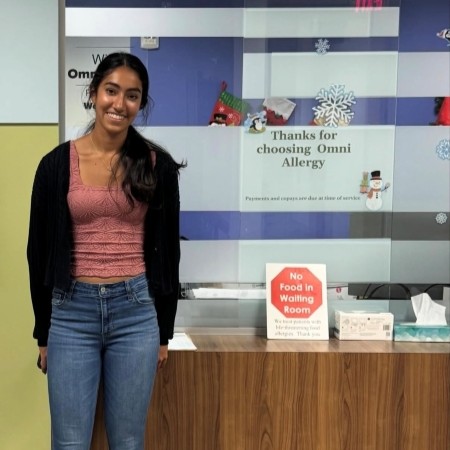
Meet Daily Point of Light Award honoree Amara Barger. Read her story, and nominate an outstanding volunteer or family as a Daily Point of Light.
When she was a young child, Amara Barger ate a muffin at a close friend’s house without knowing it contained cashew butter. She hadn’t told anyone about her tree nut allergy, and she didn’t have her EpiPen. Her friend’s family called an ambulance, and she ended up in the ER.
That scare inspired Amara to create Allerbusters, a nonprofit that distributes teal-colored allergy bracelets, raises awareness, and builds community for kids with allergies. Now 17 and a high school senior in Atlanta, she has partnered with more than 60 organizations, including pediatric allergy clinics, schools, and camps, across 20 states and 10 countries, reaching more than 3,500 children.
What inspired you to start Allerbusters?
I’ve had allergies my whole life. Cashews, pistachios, and walnuts are my main ones. When I was 8 or 9, I was at a close friend’s house. Our parents are really close, so I thought it was a safe environment. I didn’t realize I needed to speak up about my allergy, and I was a little embarrassed to tell them it was something they should worry about. I didn’t want to be a burden in their space. I ended up eating a muffin with cashew butter in it, which I never thought would be an issue, and I didn’t have my EpiPen. They had to call an ambulance, and I went to the ER.
It was really shocking to realize that my embarrassment about speaking up, or just something so simple as eating a muffin, could put my life in danger. I was a young kid who was pretty familiar with my allergy, and I still had this issue. I’m sure so many other kids face the same thing. Some don’t know when to speak up, some are so young they don’t understand what an allergy is, and the adults around them might not know about their allergy at all.
That’s how Allerbusters was born, as a visual cue and another layer of protection for kids and, honestly, anyone with allergies. More recently, I’ve realized it’s also a way for kids with allergies to find each other. When I’m around other kids with allergies, they understand the things we share, like being scared to raise your hand to tell a waiter you have an allergy. Other people take that for granted, but it can be uncomfortable. Through Allerbusters, kids can find people who share that, and I think that’s really special.
How did Allerbusters grow from an idea into what it is today?
It’s been a very long process. It started pretty soon after that incident, when I was around 10 and part of a startup incubator for young kids. They helped me bring my idea to life, and it started out as a for-profit. I didn’t even have the teal color figured out. I tried different versions of the product and different target markets, like going directly to parents or to schools. Eventually I found a system that worked at the time: I sold bracelets to schools, summer camps, and churches so teachers would have a way to know which kids had allergies.
Then COVID hit, and I took time away from the project. I got busy and realized I wanted to learn more about business before trying to run my own thing. After COVID, I came back because I still cared about the issue, but the space had changed a lot. Some of my earlier customers had improved their systems or told me it wasn’t a great fit anymore, and they suggested other things to try. I was in feedback-gathering mode for a while, and after trying a lot of different things, we landed on our new system.
We also became a nonprofit in 2024. The main point of this organization is to spread awareness, help kids find each other, and make conversations about allergies more common and less scary, and being a nonprofit makes it easier to scale that and keep those goals at the center. Now we distribute kits of bracelets, flyers, and resources to partners like allergy doctors, allergy awareness events, and research institutions. We’re in 20 states and 10 countries.
What has the feedback been from parents and doctors?
It’s been overwhelmingly positive. We’ve heard about a little boy whose classmates asked him about his bracelet. He told them about his allergies, and they understood in a way they hadn’t before. The bracelet invited that conversation, which is ultimately the goal. We’ve also heard from the parents of a little girl who now feel safer sending her places. She was able to join a soccer team and go to dinners she hadn’t been able to attend before.
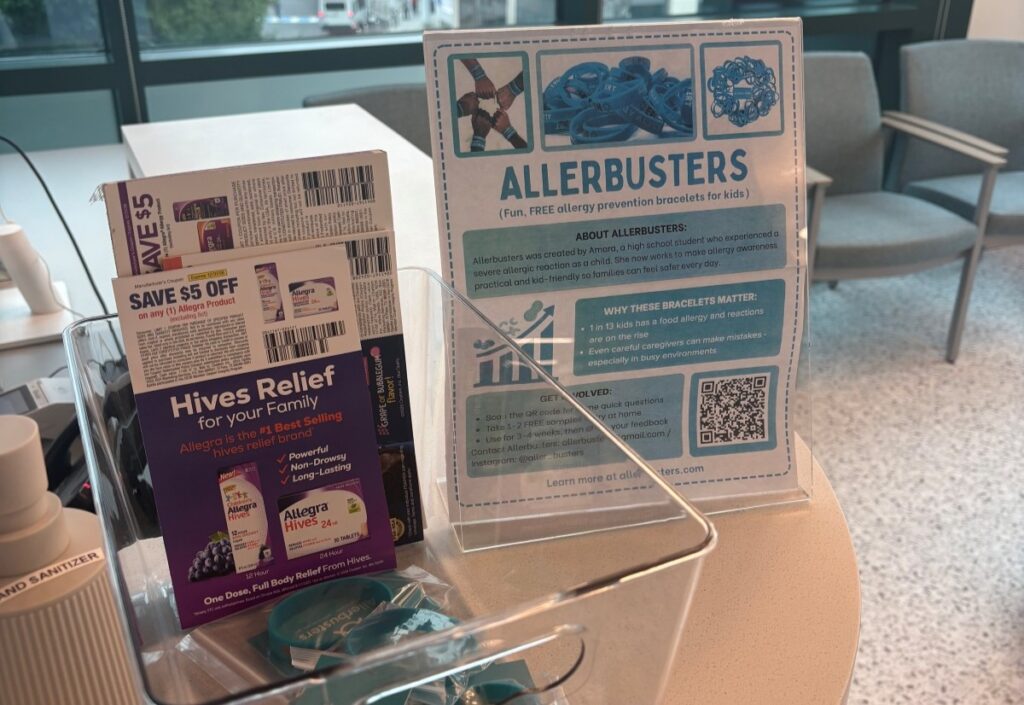
Hearing those individual stories means more to me than rattling off our statistics. Next to our bracelets, there’s a QR code you can scan to order more, and it links to a Google form with optional feedback questions. Reading parents’ responses, like how happy they are that their kid has a bracelet or that their kid saw one and really wanted it, is very special because I can’t meet everyone in person. It lets me hear their voices.
What’s next for Allerbusters?
One of the big things I’m working on is building a team to sustain it, because I’m going to college next year in a new city. I definitely plan to continue, but some relationships will be harder from far away. We have about six high school students and two college students, and I want a team in different parts of the country so we each have a home base. I’m still figuring out how to navigate leadership and responsibilities. When I’m in a new place, there will be so many more organizations to reach out to, and I can get the in-person experiences I haven’t been able to get while our partners are far away.
We’re also working to expand our custom bracelets, which multiple partners have asked for. Funding is harder there because each custom bracelet is a lot more expensive, and you can’t mass-produce them. But we just got a new grant that comes with coaching, and I’m excited to use it to focus on custom bracelets.
Any advice for people who want to start volunteering or their own nonprofit?
It’s never too early. I started very young, and I’ve received a lot more no’s than yeses. Even when I came back to this topic, I got a lot of no’s, and I probably had to change my model three times. Be willing to change, and realize that your first idea might not be the best and that other people have valuable feedback to give.
Sometimes I was so connected to my project that I thought the people who disagreed just didn’t understand what I was trying to do. Once I changed that mindset and decided to learn from them, it led me to where I am today. And don’t give up after a couple of no’s. You could just be talking to the wrong people, which I probably was at some points along the way.
What do you hope people take away from your story?
This is a cause I really care about, and I hope people who care about a cause will try to make a difference in some way. For me, it’s a way to take back some control over an issue that initially seemed very uncontrolled. Being able to help others manage their allergies, as well as myself, has been very special.
I also hope people realize that for a lot of issues, they’re not the only one going through it. With allergies, I sometimes felt like I was the only one with this problem and no one really got it. But through Allerbusters, I’ve met so many people with allergies, some much more severe than mine. You’re not going through this alone. There are communities of people who understand and are very supportive.
Do you want to make a difference in your community like Amara? Find local volunteer opportunities.